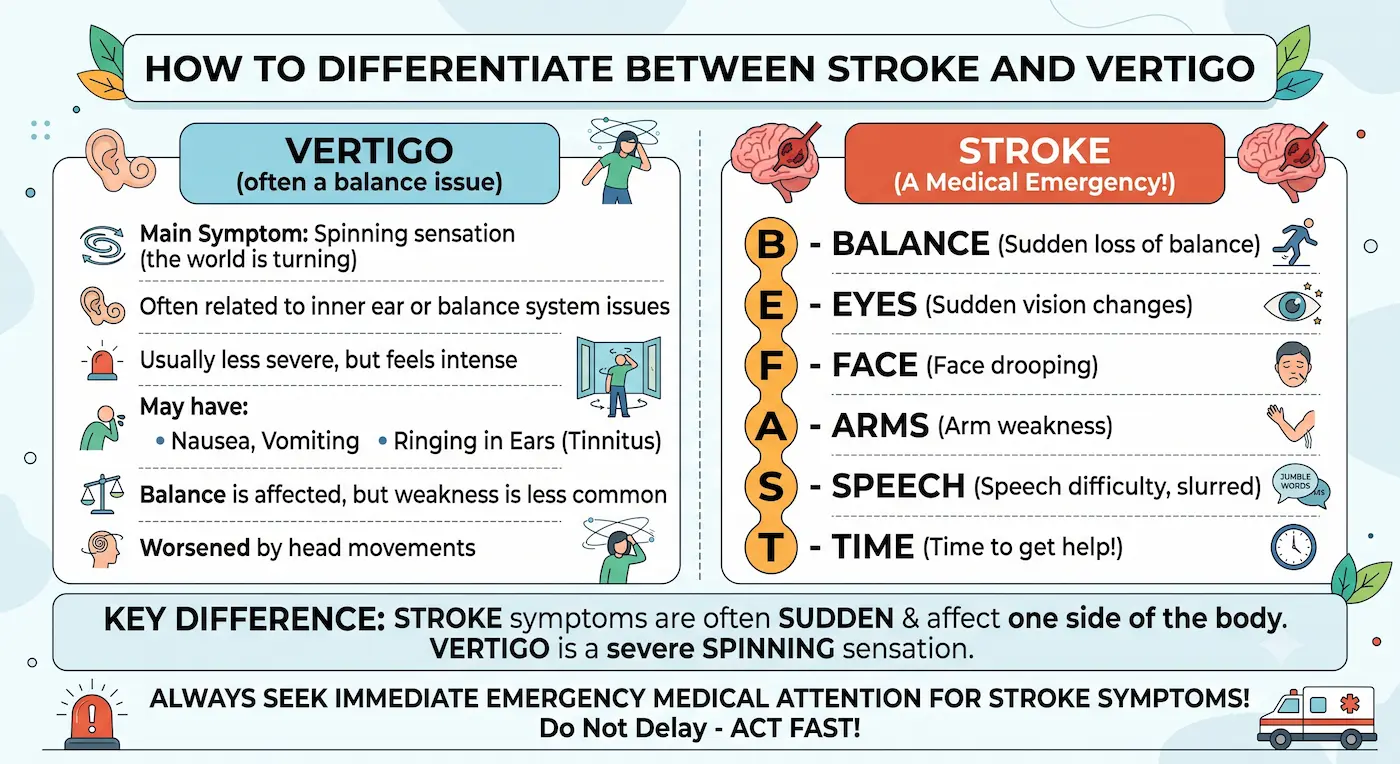
Among elderly patients presenting to emergency departments with dizziness or vertigo as their leading symptom, approximately 4% to 10% have a stroke, and misdiagnosis of peripheral vestibular failure is estimated to account for up to 60% of stroke cases during initial patient classification. Read that carefully. More than half of posterior circulation strokes presenting as dizziness are initially misidentified as an inner ear problem. In an elderly patient in a Gurgaon apartment, sent home with a vertigo tablet after what turned out to be a cerebellar stroke, the consequences of that misidentification can be permanent.
"Chakkar Aana" Is Not One Condition
In urban Indian households, dizziness in an elderly parent that is 'chakkar aana' is among the most dismissed symptoms in senior healthcare. It is attributed to low blood pressure, to the heat, to inner ear problems, to anaemia, to "old age." The family gives the senior water, asks them to lie down, and calls the doctor only if it persists for days or if the senior falls.
This response is appropriate for many causes of dizziness. It is dangerous for a specific subset. The clinical challenge is that the most benign cause of vertigo in the elderly and the most catastrophic cause can, in their early stages, feel almost identical to the patient and an untrained observer.
Dizziness increases with age and is among the most common complaints in the elderly age group. Progressive disequilibrium of ageing is associated with an increased risk of falls, and imbalance and falls are the leading cause of hospitalisation and accidental death in older individuals. But within this broad category, the clinical imperative is to rapidly identify which dizziness is peripheral and manageable, and which is central and potentially life-threatening.
Two Entirely Different Systems, One Symptom
The vestibular system is responsible for spatial orientation and balance, it has two anatomically and clinically distinct components. Understanding this distinction is the key to understanding when dizziness is dangerous.
The peripheral vestibular system comprises the inner ear structures: the semicircular canals, the utricle, the saccule, and the vestibular nerve. These structures detect head movement and gravity, and send signals to the brainstem and cerebellum to coordinate eye movement and postural control. Disorders of the peripheral system include BPPV, vestibular neuritis, Ménière's disease, these are common, frequently benign, and mostly treatable.
The central vestibular system comprises the vestibular nuclei in the brainstem and the cerebellum, which process and integrate signals from the inner ear, the visual system, and proprioceptors. Disorders of the central system such as posterior circulation stroke, cerebellar infarction, brainstem demyelination are less common but carry serious neurological risk and require urgent intervention.
In older adult populations, targeted assessment is imperative as central causes of vertigo are more common among this demographic and elevate the risk of falls and associated complications.
The most common peripheral cause by far is BPPV - Benign Paroxysmal Positional Vertigo. BPPV is the most common cause of vertigo and dizziness from children to old age, peaking at about 60 years, with an increasing incidence in the elderly population. It occurs when calcium carbonate crystals (aka otoconia) which normally sit in the utricle of the inner ear become dislodged and migrate into the semicircular canals, where they generate false motion signals with certain head positions. The result is brief, intense spinning triggered by specific movements: lying down, rolling over in bed, tilting the head back to look up, or bending forward.
Among community-dwelling adults over 50 with dizziness, BPPV was identified as the vestibular cause in 63% of those with a confirmed vestibular disorder which is substantially higher than previously reported figures from dizzy clinic populations. The good news about BPPV is that it responds to a specific physical repositioning manoeuvre i.e. the Epley manoeuvre with high success rates when performed correctly. The critical clinical task is first confirming that what appears to be BPPV is not, in fact, something more dangerous mimicking it.
The Clinical Reality for Indian Seniors in Gurgaon
As an ENT surgeon working in this population, vertigo is one of the conditions I encounter most frequently. What I observe consistently in Gurgaon's elderly population is a threefold pattern.
First, BPPV is dramatically undertreated. Patients who have had months of positional dizziness, spinning when they turn over in bed, dizziness when they bend to pick something up are given vestibular sedatives (stemetil, betahistine) on a long-term basis without anyone ever attempting a diagnostic manoeuvre or therapeutic repositioning. These medications suppress the symptom without resolving the underlying crystal displacement, and in elderly patients their sedating effects increase fall risk.
Second, dizziness caused by medication is systematically overlooked. Medications particularly antiepileptics, sedatives, antihypertensives and analgesics are common causes of dizziness in the elderly, and many Gurgaon seniors are on combinations of these. A senior who starts a new antihypertensive and develops dizziness the following week has a medication-related cause that requires a prescription review, not a vestibular diagnosis.
Third and most importantly the red flags for central vertigo are not widely known among families. A senior who develops sudden, persistent, severe dizziness associated with any neurological symptom is experiencing a potential medical emergency. The delay between symptom onset and emergency presentation in posterior circulation stroke is often measured in days, not hours, in Indian households. That delay has permanent neurological consequences.
When Is Dizziness Dangerous? The Critical Distinction
Peripheral vertigo: likely benign, requires evaluation but not emergency: Brief episodes triggered by specific head positions; spinning sensation that lasts seconds to a few minutes then resolves; nausea often present but no vomiting; hearing may be affected (in Ménière's disease); no neurological symptoms; patient can walk, though unsteadily.
Central vertigo: potentially life-threatening, requires emergency evaluation:
Inability to stand or walk unassisted is a major red flag for a central (cerebellar) cause of vertigo, even in the absence of other focal neurological deficits. The clinical community uses a mnemonic for the additional red flags: the 5 Ds. The 5 Ds are red flag neurological signs and symptoms that often present in combination with vertigo in central aetiologies like brainstem or cerebellar stroke: Diplopia (double vision), Dysarthria (slurred speech), Dysphagia (difficulty swallowing), Dysmetria or limb ataxia (clumsiness), and Dysphonia (hoarse voice).
Additional central red flags: sudden onset of the most severe dizziness the patient has ever experienced; dizziness that is constant and not triggered by position change; new-onset severe headache accompanying dizziness; facial numbness or one-sided weakness alongside dizziness; and visual disturbance or double vision appearing with the dizziness episode.
The clinical bedside tool used to distinguish central from peripheral acute vertigo is the HINTS exam: Head Impulse, Nystagmus, Test of Skew. The HINTS examination is a battery of bedside clinical tests used to differentiate central and peripheral causes, and is the best known clinical test battery in cases of acute dizziness and vertigo. This is a physician-performed examination & families cannot perform it, but knowing it exists helps families understand why getting an elderly patient with new-onset constant dizziness to a physician promptly, rather than managing at home, is the correct response.
Practical Steps: What Families Should Do
1. Learn the BPPV pattern and its specific trigger: position-related, brief, rotational Classic BPPV produces brief spinning episodes, seconds to one or two minutes, triggered by specific head movements: rolling over in bed, looking up, bending forward. If your parent's dizziness fits this pattern precisely, it is likely peripheral and warrants an ENT or neurologist referral for the Epley repositioning manoeuvre. Do not give vestibular sedatives as a long-term solution without a confirmed diagnosis.
2. Know the 5 Ds and treat any one of them as an emergency If dizziness in your parent is accompanied by any of the following: double vision, slurred speech, difficulty swallowing, sudden clumsiness in the hands or limbs, or a changed or hoarse voice, call for emergency assistance immediately. Do not wait to see if it resolves. Do not drive to the nearest clinic. Call an ambulance. This combination is a posterior circulation stroke until proven otherwise.
3. Check medications before assuming a vestibular diagnosis If dizziness appeared or worsened after a new medication was started or a dose was changed, raise this with the prescribing physician before any vestibular workup. Antihypertensives causing orthostatic hypotension, sedatives, antihistamines, and certain antibiotics (particularly aminoglycosides) are all documented causes of drug-induced dizziness in elderly patients.
4. Do not let a senior with active dizziness navigate stairs or heights alone Regardless of cause, active vertigo dramatically increases fall risk. Until the cause is identified and treated, ensure the senior has assistance or support for any stair navigation, bathroom use at night, and movement around the apartment. A senior with undiagnosed BPPV who gets up at 3 AM to use the bathroom and triggers a spinning episode on the stairs is at immediate fall risk.
5. Insist on a proper diagnostic evaluation not just a prescription A senior presenting with vertigo should have a clinical examination that includes assessment of nystagmus, gait, and neurological function, not simply a prescription for betahistine or stemetil based on the symptom description alone. If the treating physician has not examined the patient's eyes, gait, and neurological status, request this explicitly. A prescription without an examination is inadequate management for new-onset vertigo in an elderly patient.
At Aamra Seniors Club, our doctor-led day programme means a physician is present and observing our members daily so neurological changes, new dizziness, and altered gait are noticed and acted on, not missed between quarterly appointments. Book a Day Pass.
Critical Warning: The BE-FAST stroke recognition tool applies directly to dizziness in elderly patients. BE-FAST stands for:
Balance (sudden loss)
Eyes (sudden vision change)
Face drooping
Arm weakness
Speech difficulty
Time to call for emergency help.
Any sudden, severe dizziness in an elderly patient accompanied by any element of BE-FAST is a stroke emergency. Do not give the patient food or water as swallowing may be compromised in a brainstem stroke. Do not let the patient sleep it off. Time to treatment in ischaemic stroke is the single most important determinant of outcome. Every minute of delay causes irreversible neuronal loss.
Doctor's Note
Vertigo is one of the conditions I feel most strongly about as an ENT surgeon, because it sits directly in my clinical territory, the inner ear, the vestibular nerve, the connections to the brainstem and because I have seen, on more than one occasion, what happens when a central cause is missed. I have seen a senior who was given betahistine for three days for what his family called "chakkar" who turned out to have had a cerebellar stroke on day one. I have also seen patients who had spent months convinced something was gravely wrong with them, miserable with spinning and fear, who needed nothing more than a single Epley manoeuvre and were completely better within 48 hours. These two kinds of patients required opposite responses. Distinguishing between them requires a physical examination not a symptom description and a prescription over the phone. If your parent develops new dizziness, please get them seen. And if that dizziness comes with any of the 5 Ds i.e double vision, slurred speech, difficulty swallowing, clumsiness, or voice change please treat it as an emergency.
— Dr. Akanksha Saxena, ENT Surgeon & Medical Director, Aamra Seniors Club, DLF Phase 1, Gurgaon