In a study of elderly Indians with type 2 diabetes aged 90 years and above, the prevalence of peripheral neuropathy was 89.8% and coronary artery disease was 60.3%, figures that represent the cumulative biological cost of decades of diabetes. Most families managing an elderly diabetic parent in Gurgaon are focused on blood sugar numbers. They are rarely focused on what chronically elevated blood sugar is quietly doing to the kidneys, the eyes, the nerves, the heart, and the brain. By the time complications become visible, they are often already advanced. Knowing what to look for, and when, is the clinical knowledge that changes outcomes.
HbA1c Is Not the Whole Story
When a 69-year-old woman attends her quarterly diabetologist appointment, the conversation typically centres on two numbers: fasting blood glucose and HbA1c. If both are within acceptable range, everyone goes home reassured. What is rarely done systematically is a structured screen for the complications that may already be developing silently alongside those numbers.
Diabetes is a progressive disorder leading to complications broadly divided into microvascular disease, affecting the retina, kidney, and peripheral nerves, and macrovascular disease, affecting the heart, brain, and peripheral arteries. These complications do not wait for poor glucose control to appear. They develop over years, are frequently asymptomatic in their early stages, and become irreversible if detected late. In Indian clinical practice, complication screening is inconsistent even in urban settings, and families rarely know which symptoms to watch for or which investigations to request between annual check-ups.
Older adults with diabetes are also more likely to experience geriatric syndromes such as falls, dementia, depression, and incontinence consequences of diabetic complications that extend well beyond the classically described microvascular and macrovascular categories. For an elderly patient in Gurgaon managing multiple conditions simultaneously, these geriatric dimensions of diabetes are almost never explicitly addressed.
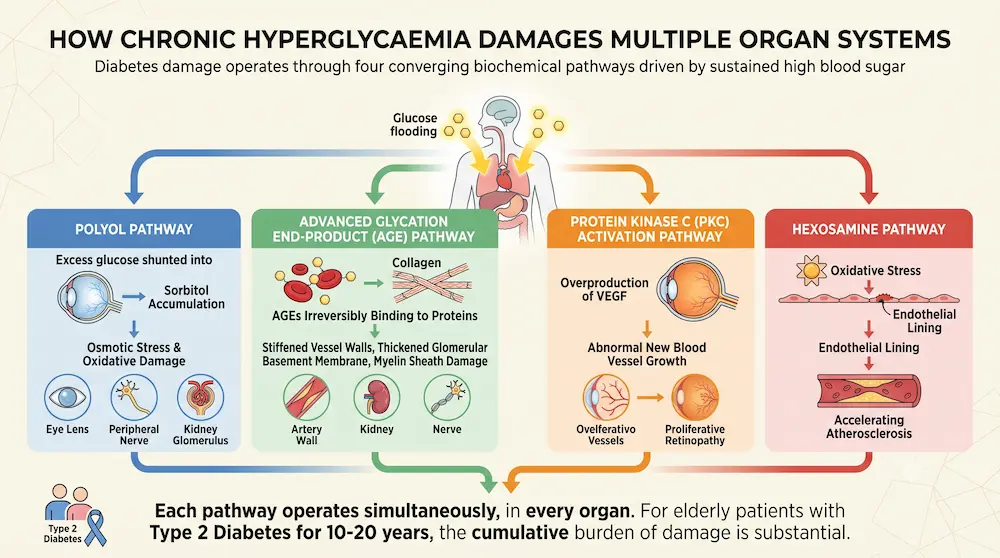
How Chronic Hyperglycaemia Damages Multiple Organ Systems
The damage that diabetes causes to organs operates through four converging biochemical pathways, all driven by sustained hyperglycaemia.
The polyol pathway shunts excess glucose into the production of sorbitol, which accumulates in tissues including the lens of the eye, peripheral nerves, and kidney glomeruli, causing osmotic stress and oxidative damage. The advanced glycation end-product (AGE) pathway results in glucose molecules binding irreversibly to proteins and lipids, stiffening blood vessel walls, thickening the glomerular basement membrane in the kidney, and damaging the myelin sheaths of peripheral nerves. The protein kinase C activation pathway drives overproduction of vascular endothelial growth factor (VEGF) in the retina, leading to abnormal new blood vessel growth that is the hallmark of proliferative diabetic retinopathy. The hexosamine pathway generates oxidative stress that damages the endothelial lining of blood vessels throughout the body, accelerating atherosclerosis.
Each of these pathways operates simultaneously, in every organ, for as long as blood glucose remains elevated above normal. In elderly patients who have had type 2 diabetes for ten, fifteen, or twenty years, the cumulative burden of this damage is substantial, even if glucose has been reasonably controlled.
The Clinical Warning Signs: What to Watch for in Each System
The Kidneys: Diabetic Nephropathy
Diabetes has been found to be the primary cause of kidney failure in nearly 45% of patients undergoing dialysis, and nearly 15 to 23% of diabetic patients suffer from moderate to severe chronic kidney disease. In Indian senior patients, diabetic nephropathy is frequently identified late because its early stages are entirely asymptomatic.
The warning signs families must know: swelling of the ankles and feet appearing gradually over weeks; frothy or foamy urine, which indicates protein leaking into the urine; unexplained fatigue and reduced appetite in a patient whose blood sugar appears controlled; and rising creatinine on a blood test. The clinical investigation is straightforward: a urine test for microalbuminuria and a serum creatinine with eGFR calculation. These should be done annually in every elderly diabetic patient without exception, not only when symptoms appear.
The Eyes: Diabetic Retinopathy
Diabetic retinopathy is the leading cause of preventable blindness in working-age adults globally, and its prevalence in elderly Indian diabetic patients is substantial. In a large Indian dataset, retinopathy was present in 36% of male and 26.3% of female diabetic patients. The clinical danger is that retinopathy produces no symptoms until it is advanced. By the time a patient notices blurring or visual disturbance, significant irreversible damage may have already occurred.
The warning signs: any new blurring of vision that was not previously present; floaters or dark spots that appear suddenly in the visual field; a shadow or curtain effect across part of the visual field; and difficulty reading at a distance that was previously comfortable. Annual dilated fundus examination by an ophthalmologist is mandatory for every elderly diabetic patient. Do not substitute this with an optician's check for glasses.
The Peripheral Nerves: Diabetic Neuropathy
Peripheral diabetic neuropathy affects more than 50% of elderly patients with type 2 diabetes and is characterised by neuropathic pain, sensory loss, and motor dysfunction. As discussed in our earlier piece on peripheral neuropathy, the consequences in the elderly extend beyond discomfort to include dramatically increased fall risk through impaired proprioception.
The warning signs: burning, tingling, or electric shock sensations in the feet and lower legs, particularly worse at night; numbness in the feet that makes it difficult to feel the ground; foot pain that is present at rest but reduces with walking; and any wound, sore, or pressure mark on the sole of the foot that the patient did not feel forming. The last of these is the most dangerous: a diabetic patient with peripheral neuropathy may sustain a significant foot wound and feel nothing. Foot disorders remain a major source of morbidity and a leading cause of hospitalisation among people with diabetes mellitus.
The Heart: Diabetic Cardiovascular Disease
Peripheral vascular disease and coronary artery disease both had a prevalence rate of 15.1% among diabetic patients in an Indian cross-sectional study, with microvascular complications present in over half the study population. Diabetic cardiac disease carries an additional clinical complexity: diabetic autonomic neuropathy can blunt the pain signals that normally accompany a cardiac event, producing a "silent myocardial infarction" in which a heart attack occurs without the classic chest pain that would otherwise prompt emergency care.
The warning signs of cardiac involvement in elderly diabetics: unexplained breathlessness on minor exertion that was not previously present; fatigue disproportionate to activity level; swelling of the feet and ankles (which can indicate heart failure as well as nephropathy); palpitations or irregular heartbeat; and any episode of dizziness, near-fainting, or loss of consciousness. An ECG and an echocardiogram should be part of routine annual review for elderly diabetic patients with more than ten years of disease duration.
The Brain: Cognitive Decline and Dementia Risk
Older adults with diabetes are more likely to experience dementia than age-matched non-diabetic individuals. Chronic hyperglycaemia damages cerebral small vessels, reduces cerebral blood flow, and promotes neuroinflammation all of which accelerate cognitive decline. In an elderly patient with long-standing diabetes, new-onset cognitive slowing, memory lapses, or personality change should prompt assessment that includes cognitive screening alongside routine metabolic evaluation.
The warning signs: progressive difficulty with tasks that require planning or sequence such as cooking a full meal, managing finances, navigating a familiar route; increasing repetition of questions or stories within the same conversation; and withdrawal from social engagement that was previously enjoyed. These may be the earliest detectable manifestation of diabetes-related cerebral vascular disease.
The Clinical Reality for Indian Seniors in Gurgaon
For seniors in Gurgaon, the diabetes complication burden reflects a specific demographic reality: many of these patients have had type 2 diabetes for fifteen years or more, diagnosed in their fifties, and have reached their late sixties and seventies with a complication profile that has been only partially screened and even less systematically managed.
The polypharmacy problem compounds this. An elderly diabetic patient in urban Gurgaon is typically on four to seven medications simultaneously, prescribed by multiple specialists who may not communicate with each other. Drug interactions, medication-induced kidney stress, and the cognitive burden of complex medication regimens all create additional layers of risk that sit on top of the disease's own complications.
The foot care gap is particularly acute. Daily visual inspection of both feet, prompt wound management, and annual podiatric assessment are standard of care for elderly diabetic patients globally. In Indian households, including in urban Gurgaon, this level of systematic foot surveillance is almost universally absent.
Practical Steps: What Families Must Do
1. Build a complication screening calendar and treat it as non-negotiable Every elderly diabetic patient needs annual screening for nephropathy (urine microalbumin and serum creatinine with eGFR), retinopathy (dilated fundus exam by ophthalmologist), neuropathy (clinical foot examination including monofilament test), cardiovascular status (ECG, blood pressure, lipid profile), and cognitive function (simple validated screening such as MMSE or MoCA). If any of these has not been done in the past twelve months, it should be scheduled now.
2. Inspect both feet every single day This is the most important family-executable action in diabetic senior care and the one most consistently neglected. Check the entire sole, between the toes, and around the heel daily, using a mirror if necessary. Look for any redness, blister, cut, or pressure mark. Any wound that does not show clear healing within 48 hours must be assessed medically that day.
3. Know the silent heart attack warning signs and act on them In elderly diabetic patients, a cardiac event may present without chest pain. Teach every family member to recognise the atypical presentations: sudden unexplained breathlessness, profound fatigue appearing over hours, upper back or jaw discomfort, sweating without exertion, and nausea without gastrointestinal cause. Any of these in an elderly diabetic patient warrants emergency evaluation.
4. Report new symptoms between appointments, not only at scheduled visits The quarterly diabetologist appointment is a monitoring visit, not a safety net. New symptoms appearing between appointments, including any of those described above, should be reported to the treating physician the same week they appear, not held until the next scheduled review. Build the habit of keeping a simple symptom diary that notes any new complaint, its date of onset, and its progression.
5. Raise cognitive changes explicitly with the treating physician Memory changes and cognitive slowing in an elderly diabetic patient are frequently attributed to ageing or stress and not investigated for their vascular and metabolic contributors. Raise any observed cognitive change explicitly at the next appointment and ask specifically whether a formal cognitive screen and cerebrovascular assessment are warranted.
At Aamra Seniors Club, our doctor-led day programme includes daily clinical observation, structured health monitoring, and the kind of consistent attention to diabetic warning signs that busy family caregivers find difficult to sustain alone. Book a Day Pass.
Critical Warning
Hypoglycaemia in elderly diabetic patients is more dangerous than in younger patients for two specific reasons: first, the warning symptoms of low blood sugar, including sweating, trembling, and hunger, are frequently blunted or absent in older adults, meaning a severe episode can develop without the patient experiencing any warning. Second, elderly patients are at significantly higher risk of hypoglycaemia-induced falls and cardiac arrhythmias. Any episode of confusion, unusual unsteadiness, sweating, or unresponsiveness in an elderly diabetic patient should be treated as a potential hypoglycaemic emergency. Check blood glucose immediately if a glucometer is available. If the patient is conscious and able to swallow, give glucose. If unconscious or unable to swallow, call for emergency assistance immediately.