Frailty increases the risk of 30-day mortality after surgery by a factor of 3.71, and 30-day surgical complications by a factor of 2.39, in elderly patients undergoing non-cardiac surgery. Yet most families of elderly surgical patients in India receive no structured guidance on post-operative recovery beyond a discharge summary listing medications and a wound care instruction. The gap between what the evidence says about elderly surgical recovery and what actually happens in the average post-operative household in India is one of the most consequential gaps in senior healthcare.
Discharge does not mean recovery
When a 74-year-old man is discharged from a Gurgaon hospital after a hip replacement or abdominal surgery, the family is typically handed a discharge summary, a list of medications, a wound dressing protocol, and a follow-up appointment date two weeks out. What they are rarely given is a structured recovery framework a day-by-day plan that addresses nutrition, movement, cognitive monitoring, pain management, and the specific risks that make post-surgical recovery in elderly patients categorically different from recovery in a younger adult.
Families do their best. They keep the senior rested, fed, and comfortable. And in doing so, they sometimes inadvertently create the conditions for the very complications they are trying to prevent: prolonged bed rest accelerates muscle loss and deep vein thrombosis risk; inadequate protein intake slows wound healing; social withdrawal after surgery compounds the risk of post-operative delirium; and missed early warning signs of surgical site infection go unreported until the next scheduled appointment.
Post-surgical recovery in seniors is a clinical process, not a rest period. The families who understand this distinction get meaningfully better outcomes.
Why elderly surgical recovery is biologically different
Three biological realities make post-surgical recovery in elderly patients distinct from that in younger adults and all three must be addressed in a structured recovery plan.
Frailty and reduced physiological reserve. Sarcopenia is considered a strong predictor of postoperative falls, hospitalisation, infection, delirium, and death in older individuals. Empirical research suggests that older individuals with frailty have an increased likelihood of hospitalisation, postoperative cognitive decline, and early mortality. Frailty is not simply old age, it is a measurable state of reduced physiological reserve in which the body's capacity to recover from the metabolic stress of surgery is significantly diminished. A frail elderly patient undergoing the same surgery as a robust elderly patient of the same age has a substantially different risk profile, and their recovery plan must reflect that.
Post-operative delirium. This is the most commonly missed and most consequential complication of surgery in elderly patients. Assessment of preoperative frailty predicted postoperative delirium within 72 hours and up to 7 days after surgery and post-operative delirium is not simply confusion that resolves. It is associated with prolonged hospitalisation, accelerated cognitive decline, and increased mortality. In the home setting, families frequently misread post-operative delirium the sudden onset of confusion, agitation, disorientation, or unusual sleepiness in the days after surgery as the effects of anaesthesia wearing off, or as pain medication side effects, or as emotional distress. These are dangerous misreadings. Delirium in an elderly post-operative patient is a medical emergency signal.
The ERAS evidence base. Enhanced Recovery After Surgery (ERAS) protocols are the most rigorously studied framework for post-operative management. Essential elements of ERAS encompass reduced preoperative fasting, early introduction of oral nutrition, improved pain control strategies, and facilitating prompt postoperative mobilisation. ERAS group patients in a prospective comparative analysis demonstrated significantly faster functional recovery: earlier bowel movement, faster mobilisation, and shorter hospital stays, along with superior pain control and reduced opioid consumption all outcomes of direct relevance to elderly patients at risk of deconditioning and opioid-related complications.
The clinical reality for Indian seniors
For seniors in urban India, the post-surgical period carries specific local challenges that compound the general biological risks.
High-rise apartment living creates a mechanical barrier to early mobilisation stairs, lobby distances, and the absence of safe outdoor walking space within immediate reach of the apartment make guided movement harder to implement than in a ground-floor home environment. Lifts that are being serviced, uneven parking areas, and the general infrastructure of urban apartment complexes are real functional obstacles for a senior recovering from hip, knee, or abdominal surgery.
The family caregiver in this demographic is typically an adult child in full-time employment, a spouse who may themselves be elderly with their own health limitations, or a domestic helper without medical training. None of these configurations reliably provides the consistent, medically informed monitoring that structured post-operative recovery requires. The result is a recovery environment that is loving and well-intentioned but frequently under-equipped to catch early warning signs or implement evidence-based steps.
7 Proven Steps for Post-Surgical Recovery in Seniors
Step 1: Begin mobilisation within 24 hours of surgery unless explicitly contraindicated
Early mobilisation is the single most impactful post-operative intervention. Facilitating prompt postoperative mobilisation is a core element of ERAS protocols precisely because prolonged bed rest in elderly patients initiates a rapid cascade: muscle mass begins declining within 48–72 hours of immobility, deep vein thrombosis risk increases significantly, respiratory complications from shallow bed-rest breathing accumulate, and the psychological impact of being bedbound accelerates depressive symptoms that impair recovery motivation.
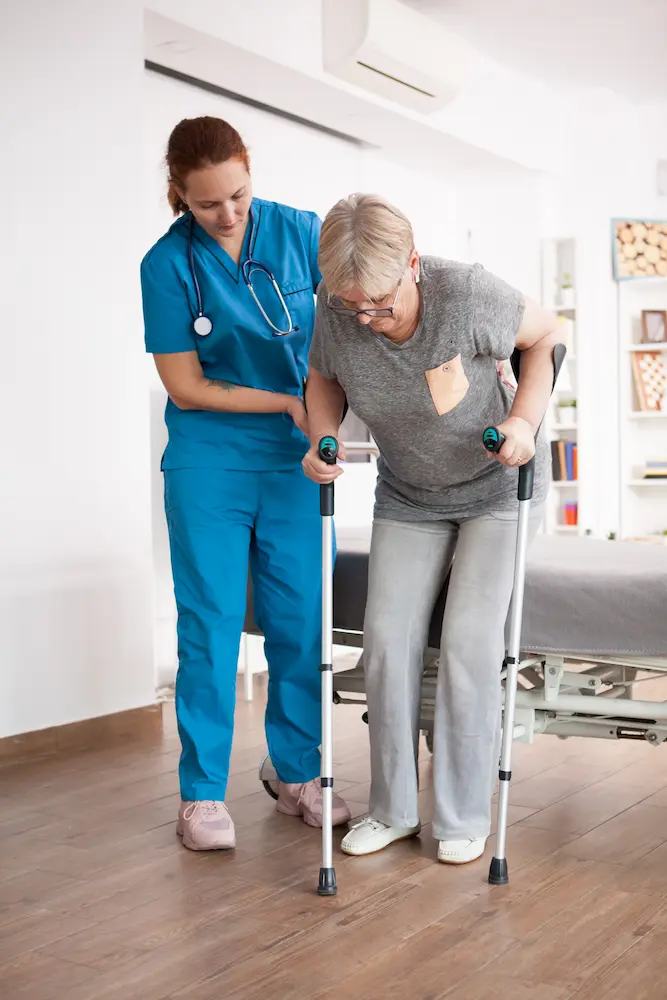
Mobilisation does not mean walking laps. On day one post-discharge, it means sitting upright in a chair, performing ankle pump exercises, and standing with support. On day two or three, it means supervised walking to the bathroom and back. The progression should be graduated, supervised, and guided by a physiotherapist but it should begin immediately. "Rest until the follow-up appointment" is not evidence-based post-operative advice for an elderly patient.
Step 2: Prioritise protein intake starting from the first day home
Wound healing and muscle recovery are protein-dependent processes. Daily protein supplementation initiated within 24 hours post-operatively and maintained for at least 14 days has been shown to improve wound healing outcomes and reduce complication rates. For an elderly patient already at risk of sarcopenia, post-surgical catabolism the body's tendency to break down muscle protein as an energy source during recovery is a clinically significant threat.
Target a protein intake of at least 1.2 to 1.5 g per kilogram of body weight daily during the recovery period. For a 60 kg elderly woman, this means approximately 72–90 g of protein daily considerably more than most elderly Indians consume habitually. High-quality protein sources include eggs, paneer, dal with rice (complementary proteins), curd, and where appropriate, a physician-supervised protein supplement. Families should treat post-operative protein intake with the same seriousness they give to medications.
Step 3: Monitor for post-operative delirium actively every day for the first week
Post-operative delirium can develop within 72 hours and persist up to 7 days after surgery and its early signs are frequently missed in home settings. Families must know specifically what to watch for: sudden onset of confusion in a previously oriented person; reversal of sleep-wake cycle (sleeping through the day, awake and agitated at night); unusual aggression or agitation; visual hallucinations; or unexplained withdrawal and excessive sleepiness.
Any of these signs in an elderly patient within seven days of surgery requires same-day medical contact not a wait-and-see approach. Document what the senior is saying and doing, note when symptoms started, and report this to the treating team immediately. Post-operative delirium that is identified and managed early has considerably better outcomes than delirium that has been running unrecognised for several days.
Step 4: Manage pain without defaulting to opioids
Opioids prescribed for post-operative pain carry specific risks in elderly patients: falls (due to sedation and impaired balance), constipation that can be severe and require intervention, cognitive clouding that is difficult to distinguish from early delirium, and physiological dependence with extended use. The ERAS approach to post-operative pain emphasises multimodal analgesia combining paracetamol, short-term low-dose NSAIDs where renal function permits, nerve blocks where appropriate, and non-pharmacological interventions including ice application, positioning, and guided breathing to minimise opioid exposure without undertreating pain.
Families should understand that the goal is not zero pain it is pain controlled well enough to allow early mobilisation and adequate sleep. If a senior is in pain that prevents them from sitting up, walking, or sleeping, this is undertreated pain requiring medical review, not an indication to remain in bed.
Step 5: Prevent wound complications through structured monitoring
Wound complications in elderly patients develop faster and with less obvious warning than in younger adults, partly because the inflammatory response is blunted and may not produce the robust redness and warmth that would signal infection in a younger person. Daily wound inspection is mandatory. Look specifically for: increasing redness spreading beyond the wound margin; wound warmth; any discharge that is cloudy, green-yellow, or foul-smelling; opening of wound edges; and fever above 38°C. Any of these findings should prompt same-day medical contact. Do not re-dress an infected wound at home and hope it resolves.
Step 6: Address the nutritional and hydration gap aggressively in the first two weeks
Post-surgical elderly patients frequently eat and drink substantially less than they need, for predictable reasons: post-anaesthesia nausea suppresses appetite in the first days; pain medication causes constipation and reduces appetite; the disruption of routine removes the social and environmental cues that normally trigger eating; and the senior may be reluctant to drink fluids to avoid the effort of going to the bathroom. The result is a nutritional and hydration deficit that impairs wound healing, immune function, and cognitive clarity.
Families should ensure regular, small-volume meals every three to four hours rather than three large meals; include easily digestible, high-protein foods at every meal; and monitor urine colour as a hydration indicator pale yellow is adequate, dark yellow or amber indicates significant dehydration. Where appetite is genuinely poor, a short-term nutritional supplement drink recommended by the treating physician is appropriate.
Step 7: Plan structured re-engagement with cognitive and social activity from week two onward
Post-operative cognitive decline is distinct from acute delirium, it can manifest as a subtle but persistent reduction in memory, processing speed, and executive function in the weeks following major surgery under general anaesthesia. Older individuals with frailty have an increased likelihood of postoperative cognitive decline. The most effective mitigation is structured cognitive and social re-engagement beginning in the second week of recovery, once the acute physical recovery phase has stabilised.
This means conversation, familiar music, supervised reading, simple card games, gentle reminiscence activities not screen time in isolation. Social engagement activates cognitive circuits, reduces depression risk, and has a documented protective effect on post-operative cognitive outcomes. In Gurgaon's high-rise households where a senior may spend the entire recovery period in a bedroom with minimal social contact, this step is consistently overlooked and its omission has real cognitive cost.
At Aamra Seniors Club, our doctor-led day programme provides structured, supervised reintegration for seniors recovering from surgery including monitored movement, nutritional support, cognitive engagement, and clinical oversight. Book a Day Pass.
Critical Warning: The following post-operative symptoms in an elderly patient require emergency medical attention, do not wait for the next scheduled appointment: sudden confusion or behavioural change; shortness of breath or chest pain; one-sided leg swelling and calf pain (possible deep vein thrombosis); fever above 38.5°C with wound redness; inability to urinate for more than 12 hours; and any fall, however minor, in the immediate post-operative period. Falls after orthopaedic surgery in elderly patients can compromise surgical repair and must be assessed the same day.
Doctor's Note
I have seen the consequences of unstructured post-operative recovery in elderly patients which present in non-dramatic complications, such as the senior who spent three weeks in bed and lost so much muscle function that they cannot walk steadily, months after the surgery that was supposed to restore their mobility. The parent whose post-operative confusion was attributed to medications for a week before someone recognised delirium and called for medical help. Post-surgical recovery in an elderly patient is a structured clinical process with specific, evidence-based interventions for each week of recovery. It is not rest. It is not watchful waiting. It is active, informed rehabilitation. If your parent is facing surgery, ask the treating team for a written recovery protocol before the procedure not a discharge summary after it.
Dr. Akanksha Saxena, Medical Director, Aamra Seniors Club, Gurgaon