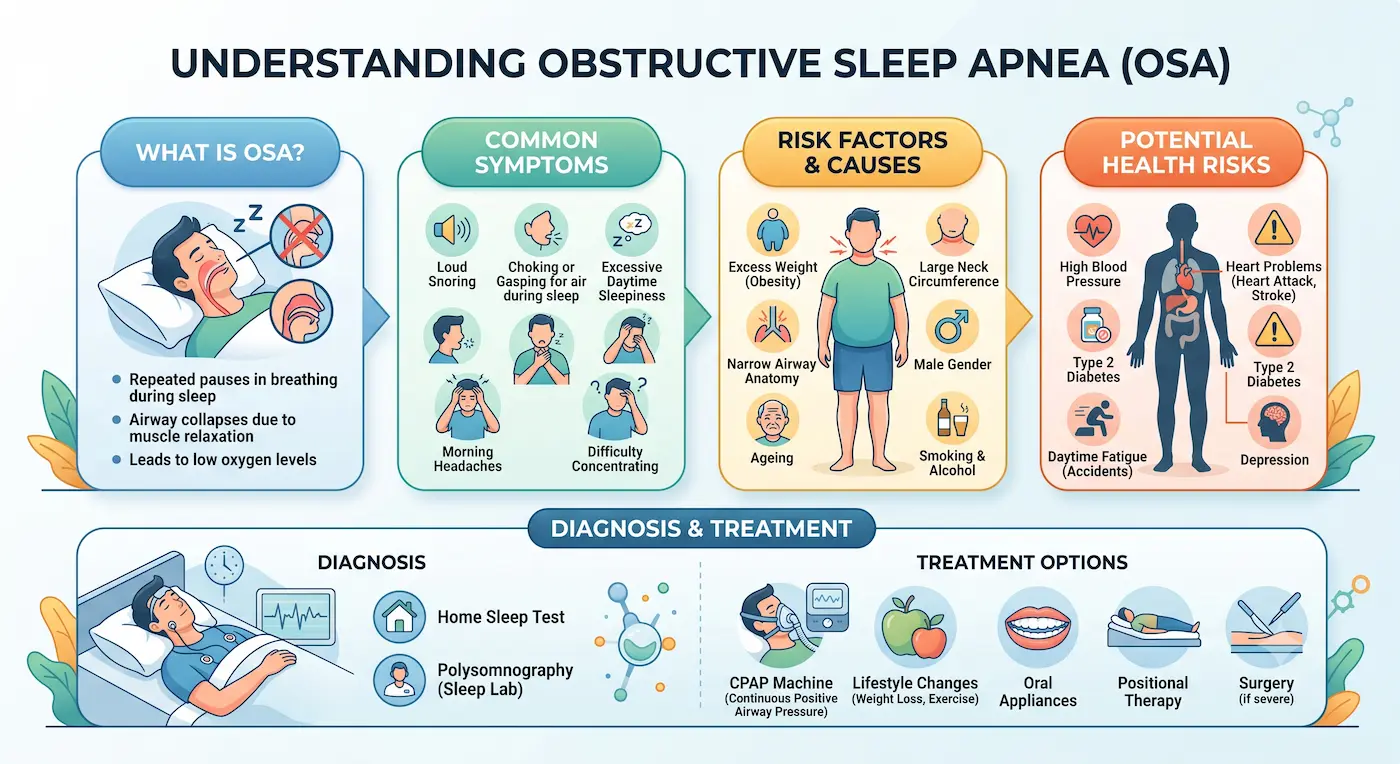
Female patients with obstructive sleep apnoea experience more mood disorders and behavioural symptoms than males instead of the prominent snoring and witnessed apnoeas often seen in male patients, women may present with subtler symptoms such as insomnia, headaches, fatigue, and mood disturbances. These are precisely the symptoms that, in an elderly woman in a Gurgaon apartment, are attributed to stress, menopause aftermath, depression, or simply old age. Meanwhile, OSA is associated with intermittent hypoxia, sympathetic overactivity, oxidative stress, and high cardiovascular mortality and morbidity and it remains undiagnosed and untreated. The condition causing the most damage is the one nobody thought to look for.
Sleep Apnoea Has a Male Face and That Is Costing Women Their Health
The public image of obstructive sleep apnoea (OSA) is a middle-aged, overweight man who snores loudly and falls asleep at the dinner table. This image is not wrong it accurately describes the typical male presentation. It is, however, dangerously incomplete.
The prevalence of OSA in women varies across different life stages pregnancy, pre- and post-menopause, and ageing leaving room to hypothesise that hormonal changes play a role. After menopause, the gender gap in OSA prevalence narrows significantly. Premenopausal women have a lower prevalence of obstructive sleep apnoea and cardiovascular disease than men and postmenopausal women, suggesting that sex hormones play a role in the pathophysiology of sleep apnoea-related hypertension.
For an elderly woman in her late sixties or seventies well past menopause, potentially managing hypertension, diabetes, or early cognitive changes the hormonal protection that once made OSA less likely has been gone for twenty years. Her risk profile may now approach or equal that of a man her age. But because her symptoms do not fit the classic snoring-and-sleepiness picture, nobody screens her.
This difference in symptomatology contributes to underdiagnosis and misdiagnosis, delaying timely treatment. The delay is not measured in weeks. In many Indian households, it is measured in years.
What Happens When Breathing Stops During Sleep
Obstructive sleep apnoea is characterised by repetitive episodes of partial or complete upper airway obstruction during sleep. The pathophysiology of OSA involves a combination of several factors that promote mechanical obstruction of the hypopharynx, which occurs repeatedly during sleep and results in intermittent hypoxia and sleep fragmentation.
Each apnoeic episode follows the same physiological sequence: the upper airway collapses, airflow stops, blood oxygen saturation drops, carbon dioxide accumulates, the brain registers a chemical crisis, and a brief arousal usually too short for the person to consciously register forces the airway open and breathing resumes. This cycle repeats dozens, sometimes hundreds, of times per night. The severity of OSA is measured by the apnoea-hypopnoea index (AHI): mild OSA is defined as an AHI of 5 to 15 events per hour, moderate as 15 to 30, and severe as above 30.
The biological consequences of this nightly pattern operate through three converging mechanisms.
Intermittent hypoxia and cardiovascular damage. Obstructive sleep apnoea syndrome is associated with severe cerebro-cardiovascular morbidity and mortality, and is an independent risk factor for atherosclerosis, arterial thrombosis, and metabolic syndrome. Each oxygen desaturation event triggers a sympathetic surge a burst of adrenaline-like activity that transiently raises blood pressure and heart rate. Repeated thousands of times per night, these surges drive sustained hypertension, endothelial dysfunction, and accelerated atherosclerosis.
Oxidative stress and systemic inflammation. Hypoxia is a critical pathophysiological element in OSA that leads to intensive sympathetic activity, in association with inflammation, oxidative stress, and procoagulant activity. The repeated cycle of hypoxia and reoxygenation generates reactive oxygen species that damage blood vessel walls, promote platelet aggregation, and sustain a low-grade systemic inflammatory state the same inflammatory milieu that drives cardiovascular disease and cognitive decline.
Cognitive impairment and dementia risk. Emerging science suggests that untreated and undertreated OSA increases the risk of developing cognitive impairment, including vascular dementia and neurodegenerative disorders like Alzheimer's disease. The relationship between OSA and Alzheimer's disease appears to be bidirectional sleep apnoea accelerates amyloid accumulation, and cognitive decline worsens airway muscle control. For an elderly woman in whom memory changes have begun, the possibility that untreated OSA is contributing to that decline is clinically significant and frequently unexplored.
The Clinical Reality for Indian Seniors in Gurgaon
In urban Indian households, the sleeping arrangement itself creates a diagnostic blind spot for OSA in elderly women. A senior woman living alone, or sleeping in a separate room from her spouse, has no one observing her breathing during sleep. The witnessed apnoea a bed partner watching someone stop breathing, then gasp is the most common trigger for OSA diagnosis in men. When that witness is absent, the diagnosis relies entirely on the patient's own symptom reporting. And because women report their OSA symptoms differently, the clinical picture is harder to recognise.
Sleep apnoea is often underdiagnosed in women because symptoms like fatigue, insomnia, morning headaches, and mood changes may be mistaken for stress, hormonal shifts, or other conditions. In an elderly Indian woman, the same symptoms are attributed to ageing, anaemia, thyroid disease, depression, or the psychological adjustment to widowhood or empty-nest life. The possibility of a sleep-disordered breathing condition is rarely in the differential.
The cardiovascular stakes are high. The lack of hormonal protection in postmenopausal women implicates oestrogen and progesterone as protective agents and their absence after menopause renders postmenopausal women as vulnerable as men to sleep apnoea-induced hypertension. For a senior woman already managing blood pressure with medication, undiagnosed OSA may be the reason her hypertension is difficult to control a known and documented relationship that is almost never investigated in clinical practice.
The cognitive dimension is particularly urgent. The relationship between OSA and Alzheimer's disease is bidirectional, and these findings emphasise the importance of sex-specific research in understanding OSA's pathophysiological connections to cognitive decline. An elderly woman developing memory lapses who has never been screened for OSA may have a treatable contributor to her cognitive decline that has never been identified.
What Families Should Do
1. Recognise the female symptom signature, it is not snoring and sleepiness In elderly women, OSA most commonly presents as: persistent fatigue that does not improve with a full night's sleep; waking with a headache, particularly at the front or top of the head, that resolves within an hour; frequent waking during the night without an obvious reason; mood changes, irritability, or low mood not explained by life circumstances; and difficulty concentrating or memory lapses that have worsened progressively. If three or more of these are present in a senior woman, OSA screening is clinically warranted.
2. Ask about night-time symptoms specifically not just daytime ones Families sharing a home with an elderly woman should specifically observe and ask about: episodes of gasping, choking, or sudden waking from sleep; restless sleep with frequent position changes; visible pauses in breathing; nocturia (frequent night-time urination, which is a documented but little-known symptom of OSA, driven by atrial natriuretic peptide release during apnoeic events); and unusual sweating during sleep.
3. Use a validated screening tool before the doctor's appointment The STOP-BANG questionnaire is a validated, eight-item screening tool for OSA risk. It assesses: Snoring, Tiredness, Observed apnoeas, Pressure (hypertension), BMI above 35, Age above 50, Neck circumference, and Gender. A score of 3 or above indicates high risk. Completing this questionnaire before a physician appointment gives the family a structured starting point for the conversation and significantly increases the likelihood that a sleep study referral will follow.
4. Understand that the gold standard is a sleep study not a clinical assessment alone A polysomnography (PSG) or a validated home sleep apnoea test (HSAT) is the definitive investigation for OSA. Clinical assessment alone, without an objective measurement of the apnoea-hypopnoea index during sleep, cannot confirm or exclude OSA. If a physician has assessed an elderly woman for sleep problems based on symptom history alone and has not suggested a sleep study, the family should ask explicitly whether one is warranted.
5. Know that treatment is available, effective, and life-changing The most effective treatment for moderate to severe OSA is continuous positive airway pressure (CPAP) therapy a mask worn during sleep that maintains continuous airway pressure, preventing collapse. CPAP reduces cardiovascular risk, improves blood pressure control, and in multiple studies has shown measurable improvements in cognitive function in OSA patients. For elderly patients with mild OSA or those unable to tolerate CPAP, mandibular advancement devices and positional therapy are alternatives. Treatment is not optional in moderate to severe disease untreated OSA in an elderly woman is a progressive cardiovascular and cognitive risk.
At Aamra Seniors Club, our doctor-led day programme includes clinical observation that picks up on fatigue patterns, cognitive changes, and mood shifts that families in busy households often miss. Book a Day Pass.
Critical Warning
If a senior woman is already being treated for hypertension that is difficult to control despite multiple medications, or if she is being treated for depression or cognitive decline that has not responded adequately to treatment, OSA must be actively excluded as a contributing factor before attributing treatment resistance to the primary diagnosis alone. Undiagnosed moderate to severe OSA is a documented cause of refractory hypertension and can produce a clinical picture indistinguishable from early dementia, including memory loss, executive dysfunction, and mood change. The investigation required is a sleep study. It is non-invasive, widely available in Gurgaon, and may change the entire management picture.