Healthy older men deprived of water for 24 hours reported no significant increase in subjective sensations of thirst or mouth dryness compared to young controls and even after rehydration was made available, they drank less than younger men and took longer for their physiological markers to normalise. This is not a matter of discipline or forgetfulness. It is a measurable, age-related failure of the biological system that tells the body it needs water. Cross-sectional studies suggest a water-loss dehydration prevalence of 20 to 30% in older populations. In Gurgaon's summers, that number is almost certainly higher.
The Problem: "I'm Not Thirsty" Is Not Evidence of Adequate Hydration
In Indian senior households, fluid intake is almost entirely governed by one signal: thirst. If a parent says they are not thirsty, families accept this and move on. Water is offered at mealtimes, perhaps with medications, and otherwise left to the senior's own initiative.
This approach works reasonably well for younger adults, whose thirst mechanism is sensitive and reliable. It fails systematically in elderly patients, because the thirst mechanism itself is broken.
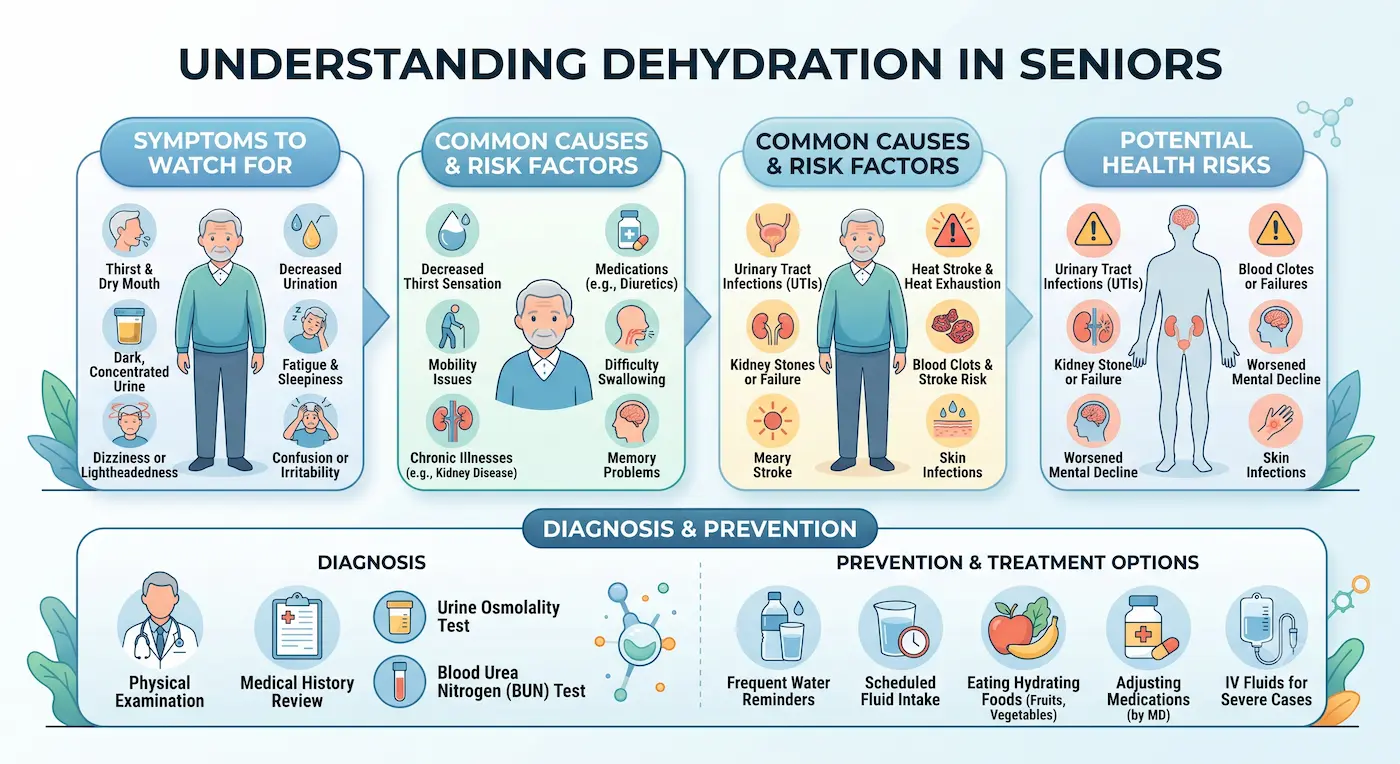
Thirst stimulated by hypovolemia, hypertonicity, and dehydration are all reduced with ageing, as is sodium appetite. A senior who is genuinely, measurably dehydrated with rising serum osmolality and falling plasma volume may feel no thirst at all. Many older adults often forget to drink sufficient water due to memory problems caused by normal ageing or diseased state, such as dementia and delirium. And there is a further compounding factor specific to Indian elderly women: fear of incontinence affects the amount consumed, with seniors deliberately restricting fluid intake to avoid the effort or embarrassment of frequent bathroom visits.
The result is a population chronically operating in a state of mild to moderate dehydration, not dramatically symptomatic, but biologically compromised across every organ system that depends on adequate fluid balance.
Four Age-Related Failures That Make Dehydration Inevitable Without Active Prevention
Four major age-related changes predispose the elderly to dehydration and hypernatremia: a decrease in total body water, an altered sense of thirst, a decrease in the renal urine concentrating ability, and a decrease in the effectiveness of ADH.
Each of these deserves a clear explanation.
Decreased total body water. As muscle mass declines with age and is replaced by fat tissue which holds less water the total body water content falls from approximately 60% of body weight in young adults to 45 to 50% in elderly patients. This reduced reservoir means that the same absolute fluid loss produces a proportionally greater degree of dehydration in an older person than in a younger one.
Blunted thirst sensation. The thirst signal originates in osmoreceptive neurons in the hypothalamus, specifically in the vascular organ of the lamina terminalis and the subfornical organ. The phenomenon of a reduced thirst in response to dehydration in ageing was first observed decades ago and has been examined extensively since. The reduced thirst and ingestive behaviour have been reported consistently in response to hyperosmotic stimuli, hypovolemic stimuli, and dehydration in both elderly humans and animal models of ageing. The signal exists, the system simply responds to it with reduced urgency and reduced behavioural response.
Reduced renal concentrating ability. The kidneys of an elderly person are less able to conserve water by producing concentrated urine. Ageing is accompanied by a gradual decline in renal function, with urine-concentrating capacities reduced in the elderly compared to younger subjects. This means that even when dehydration is developing, the kidneys cannot compensate by dramatically reducing urinary water loss the way a young kidney can.
Impaired ADH effectiveness. Arginine vasopressin (ADH) is the hormone that signals the kidneys to retain water. In the aged animal, the capacity of the AVP system to respond to dehydration is attenuated. The hormone is released in response to dehydration, but the kidney's response to it is blunted, adding a second layer of failure to the renal water conservation system.
What Chronic Mild Dehydration Does to an Elderly Body
The consequences of dehydration in elderly patients extend well beyond dry mouth and reduced urine output. They span cognition, cardiovascular function, kidney health, and physical safety.
Cognitive decline and delirium. Some evidence points toward the role played by dehydration in lowering mathematical ability, short-term memory, motor functioning, and task performance. Even mild dehydration reduces cerebral perfusion i.e. blood flow to the brain and in elderly patients whose cerebral vascular reserve is already reduced, this translates to measurable cognitive slowing, impaired attention, and in susceptible individuals, acute delirium. A senior who seems confused, agitated, or suddenly less coherent than their baseline should always have dehydration assessed before any other cause is pursued.
Falls and orthostatic hypotension. Reduced circulating volume can cause dizziness and syncope upon standing, increasing the risk of falls and fractures, particularly in older adults. Orthostatic hypotension (a drop in blood pressure on standing) is dramatically worsened by dehydration, because the reduced blood volume cannot compensate adequately when gravitational redistribution occurs on changing posture. For a senior in a Gurgaon high-rise who gets up from bed at night to use the bathroom, dehydration-related orthostatic hypotension is a direct fall risk.
Urinary tract infections. Dehydration can lead to concentrated urine, which can irritate the bladder and increase the risk of urinary tract infections. In elderly women already at heightened UTI risk inadequate fluid intake is one of the most consistently preventable contributing factors, and one of the most consistently unaddressed.
Constipation. Inadequate fluid intake reduces intestinal water content, hardening stool and slowing colonic transit. Constipation in elderly patients is frequently managed with laxatives without adequate attention to the hydration deficit that is driving it. This is both clinically inadequate and pharmacologically unnecessary in many cases.
Kidney injury. Recurrent episodes of dehydration can contribute to progressive renal damage, particularly in individuals with diabetes or hypertension. For seniors already managing chronic kidney disease, inadequate daily hydration accelerates decline in renal function in a measurable, preventable way.
The Clinical Reality for Indian Seniors in Gurgaon
Gurgaon's climate creates a specific hydration threat that is not adequately appreciated. Summer temperatures regularly exceed 42 degrees Celsius, and the transition from air-conditioned apartment interiors to outdoor environments even for brief periods induces sweat losses that an elderly person's blunted thirst mechanism will not adequately signal them to replace.
The air conditioning itself is a second, less obvious dehydration driver: air-conditioned indoor environments have low relative humidity, which increases insensible water loss through the skin and respiratory tract without producing any sensation of heat or sweating that might prompt fluid intake.
Many urban Gurgaon seniors are simultaneously on medications that independently worsen dehydration risk: diuretics for hypertension or heart failure, which increase urinary water loss; metformin and SGLT2 inhibitors for diabetes, which increase glucosuria and associated fluid loss; and laxatives, which increase GI water loss. The cumulative fluid deficit from this combination hot climate, air conditioning, blunted thirst, and dehydrating medications is significant and largely invisible to both seniors and families.
Practical Steps: Building a Hydration System That Does Not Rely on Thirst
1. Set a fixed daily fluid target and track it actively, do not wait for thirst
The main recommendation is to increase fluid consumption regardless of thirst. A practical daily target for most elderly patients is 1.5 to 2 litres of fluid approximately 8 to 10 standard glasses distributed across the day. This should be tracked actively: a marked water bottle, a simple tally, or a reminder system. Do not rely on the senior to self-regulate based on thirst. That system no longer works reliably.
2. Use urine colour as the primary daily hydration indicator
Pale yellow urine indicates adequate hydration. Dark yellow or amber urine indicates dehydration requiring immediate fluid intake. Colourless urine may indicate overhydration, which in elderly patients on certain medications can cause hyponatremia. Teach every family member and caregiver to observe and note urine colour it is the most practical, non-invasive, daily dehydration screen available and requires no equipment.
3. Build fluid intake into structured daily routines not spontaneous moments
A glass of water upon waking, a glass with each meal, a glass with each medication dose, and a glass before bed is a structured framework that delivers approximately 6 to 8 glasses without relying on thirst. Additional fluids through soups, dal, lassi, buttermilk, coconut water, and water-rich fruits provide the remainder. In Gurgaon summers, this baseline should be increased by at least two additional glasses on high-temperature days.
4. Address the fear of incontinence directly it is a documented barrier to adequate hydration
Many seniors deliberately restrict fluid intake to avoid needing to use the bathroom frequently. This is a medically dangerous habit. The conversation about this fear must be had explicitly by the family and by the treating physician. Reducing fluid intake to manage incontinence worsens bladder irritation, increases UTI risk, and concentrates urine in a way that makes incontinence episodes more urgent and more frequent, not less. Incontinence management should be addressed on its own clinical terms not by dehydrating the patient.
5. Increase monitoring during illness, heat exposure, and after diarrhoea or vomiting
Any condition that increases fluid loss gastroenteritis, fever, heat exposure, or a bout of diarrhoea must be treated as a dehydration emergency in an elderly patient. Oral rehydration solution (ORS) should be available in every home with an elderly resident. If a senior is unable to maintain oral fluid intake during an illness, medical assessment for intravenous fluid support should be sought within 24 hours not after several days of inadequate intake.
Doctor's Note
Aamra members are well aware that water is the treatment I recommend more often than almost any other intervention and the one most consistently under-delivered in elderly patients. I have seen patients with recurrent UTIs whose only missing intervention was adequate daily fluid intake. I have seen seniors labelled as having early cognitive decline whose confusion was driven by chronic dehydration. I have seen constipation managed with laxatives for months while no one increased the patient's fluid intake. The frustrating reality is that dehydration in elderly patients is almost entirely preventable but only if families stop relying on thirst as the signal that intervention is needed. In an elderly person, the thirst signal arrives late, arrives weakly, and sometimes does not arrive at all. The intervention must be structural: fixed times, measured targets, visible reminders. If your parent is not drinking at least 8 glasses of fluid daily in some form, they are almost certainly running a chronic fluid deficit. Please do not wait for them to feel thirsty before addressing it.
Dr. Akanksha Saxena,
Aamra Seniors Club, DLF Phase 1 & Sector 50, Gurgaon
At Aamra Seniors Club, hydration monitoring is built into our daily programme our team tracks intake, notices warning signs, and ensures every member reaches their daily fluid target. Book a Day Pass.
Critical Warning: Sudden confusion, agitation, or unusual drowsiness in an elderly patient particularly during or after a hot day, an illness, or a period of reduced intake is a potential sign of moderate to severe dehydration or hyponatremia (low blood sodium) and requires same-day medical assessment. Do not simply give water and wait. In elderly patients on diuretics, excessive plain water intake without electrolyte replacement can worsen hyponatremia. Always seek medical guidance before aggressive rehydration in a symptomatic elderly patient.