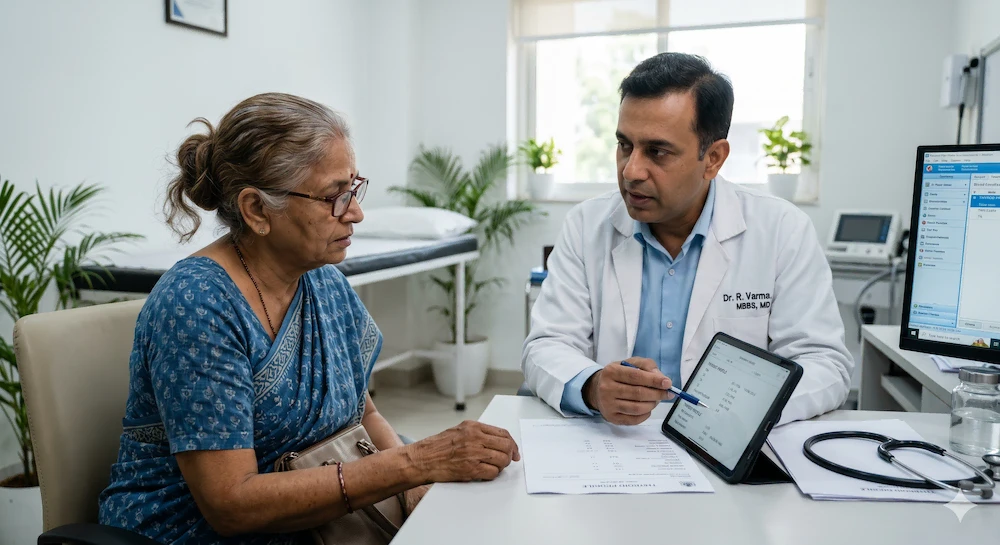
Nearly one in five Indian seniors over 65 has hypothyroidism and in a South Indian urban cohort study, a striking 93.78% of those cases were subclinical, meaning thyroid hormone levels appeared normal while TSH was already elevated. Most of these patients had no idea. Their fatigue, low mood, and slowed thinking had a name but nobody had checked for it.
The Problem: We Keep Blaming Age
When a 68-year-old woman in a DLF Phase 1 apartment tells her family she is always tired, forgetful, and unmotivated, the most common response is: "Arey, age ho gayi hai." It is old age. It is natural.
Sometimes it is. But sometimes more often than most families realise, there is a treatable hormonal condition sitting behind those symptoms, quietly misattributed to the passage of time.
Hypothyroidism in elderly patients is one of the most under-diagnosed conditions in clinical medicine. The reason is straightforward: its symptoms in older adults look almost identical to normal ageing. Fatigue. Weight gain. Constipation. Cold intolerance. Slowed cognition. Low mood. Hair thinning. Every single one of these can be explained away as the expected consequence of getting older, and frequently is.
The problem compounds further in India, where nearly one-third of patients with hypothyroidism across age groups remain undiagnosed and untreated in various regions, and where elderly patients face the additional challenge that comorbidities and concurrent medications make both recognition and treatment considerably harder.
The Science: What Happens to the Thyroid After 60
The thyroid gland is a butterfly-shaped structure at the base of the neck that produces two hormones which are triiodothyronine (T3) and thyroxine (T4), which regulate metabolism, heart rate, body temperature, mood, and cognitive function. The pituitary gland controls thyroid output by releasing thyroid-stimulating hormone (TSH): when the thyroid slows down, TSH rises in an attempt to push it harder.
In hypothyroidism, the thyroid is underperforming. In the subclinical form, TSH is elevated but T4 remains within the normal range, the pituitary is compensating, but only just.
Here is what changes with age. The clinical diagnosis of hypothyroidism in the elderly is particularly difficult because many signs and symptoms associated with hypothyroidism are commonly present in euthyroid elderly individuals, those with perfectly normal thyroid function. In other words, a doctor cannot rely on symptoms alone. The clinical picture is unreliable. And if a doctor doesn't order a TSH test, the condition remains invisible.
The commonest cause in most elderly patients is Hashimoto's thyroiditis which is an autoimmune condition in which the body's immune system gradually destroys thyroid tissue. The prevalence of Hashimoto's thyroiditis increases with ageing, which is why subclinical hypothyroidism becomes more common with each passing decade. Additionally, increased age is associated with an increase in the upper limit of the TSH reference range, which means using unadjusted reference ranges may result in misclassification of some elderly participants as having subclinical hypothyroidism, and may conversely allow genuinely elevated TSH to appear falsely normal.
This is the core diagnostic trap: standard lab reference ranges were not designed with elderly patients in mind.
The Clinical Reality for Indian Seniors
A cross-sectional study using data from the Tata Longitudinal Study of Aging in Bangalore found a 17.69% prevalence of hypothyroidism among adults aged 45 and above with 93.78% of those cases being subclinical hypothyroidism. That means the vast majority of affected individuals had no red-flag lab values. Their free T4 was normal. They would not have been flagged on a standard metabolic panel.
For urban Indian seniors in cities like Gurgaon, many of whom live alone or with a spouse in high-rise apartments, this creates a specific vulnerability. Symptoms like low energy, reduced motivation to socialise, and mild cognitive slowing are often interpreted by families as depression, loneliness, or simply the adjustment to post-retirement life. The thyroid is rarely the first thing anyone checks.
The consequences of a missed diagnosis are not trivial. Subclinical hypothyroidism is associated with risk factors for cardiovascular disease, including atherosclerosis, dyslipidaemia, and hypertension. Separately, in a study of 323 individuals over 60, elevated TSH levels were found in 30.9% of patients already diagnosed with depression, suggesting that in a significant proportion of seniors receiving antidepressant therapy, an undertreated thyroid condition may be the unaddressed driver.
The cognitive dimension is equally concerning. Individuals with subclinical hypothyroidism for a prolonged period have been found to develop cognitive impairment, especially in memory and verbal fluency. For a family watching a parent become more forgetful and withdrawn, the reflexive assumption is early dementia. The correctable endocrine cause often goes untested.
Practical Steps: What Families Can Do
1. Request a complete thyroid panel, not just TSH When taking an elderly parent for a general health check, specifically ask for TSH, free T3 (fT3), and free T4 (fT4) & not just TSH in isolation. Elevated TSH with normal fT4 indicates subclinical hypothyroidism. Normal TSH alone does not rule out all thyroid pathology.
2. Recognise the atypical symptom cluster In seniors, hypothyroidism rarely presents with the textbook picture. Look instead for this specific constellation: persistent fatigue that doesn't improve with rest, constipation that has worsened recently, unexplained weight gain, low mood, reduced interest in previous activities, and unusually dry skin or hair loss. Any three of these together, in an older adult, should prompt a thyroid screen.
3. Do not accept "age-appropriate" as a diagnosis If a doctor attributes these symptoms purely to ageing without ordering thyroid function tests, it is entirely appropriate and medically sound for a family to request bloodwork. You are not being difficult. You are being thorough.
4. Understand that treatment decisions are age-specific Current evidence suggests that treatment with levothyroxine should be considered for individuals aged 65 and older when TSH is persistently 7 mIU/L or higher, but not initiated when TSH is below 7 mIU/L. Treatment in older adults requires careful, individualised dose titration, overtreatment carries its own cardiac risks. This is a conversation, not a protocol.
5. Schedule annual thyroid screening as a fixed habit Given prevalence data from Indian cohort studies, annual TSH testing for all adults over 60 is a reasonable, low-cost precaution, particularly for women, in whom the prevalence of hypothyroidism is three times higher than in men (15.86% versus 5.02%).
Is your parent showing signs that have been brushed off as "just ageing"? At Aamra Seniors Club, our doctor-led day programme includes regular health monitoring, structured activity, and clinical oversight, so nothing gets missed. Book a Day Pass and let us take a closer look.
Critical Warning
Over-replacement with levothyroxine in elderly patients carries serious risks including atrial fibrillation, accelerated bone loss, and cardiac arrhythmias. Never adjust thyroid medication doses based on symptoms alone. TSH must be rechecked 6–8 weeks after any dose change. If your parent is already on levothyroxine and experiencing palpitations, tremors, or unexpected weight loss, report this to their physician immediately do not wait for the next scheduled visit.
Doctor's Note
In my ENT practice, I have seen patients referred for hoarseness, chronic throat-clearing, and recurrent ear fullness who turned out to have undiagnosed hypothyroidism affecting their laryngeal and mucosal tissues. Thyroid dysfunction is a systemic condition, it does not stay in one organ. What frustrates me most, clinically, is how often I see elderly patients in Gurgaon who have been managing "mild depression" or "age-related fatigue" for two or three years without anyone running a thyroid panel. A TSH test is relatively inexpensive. The cost of a missed diagnosis in cardiac risk, cognitive decline, and diminished quality of life is considerably higher. If your parent is slowing down and you are not sure why, please get their thyroid checked. It is one of the simplest things we can do.