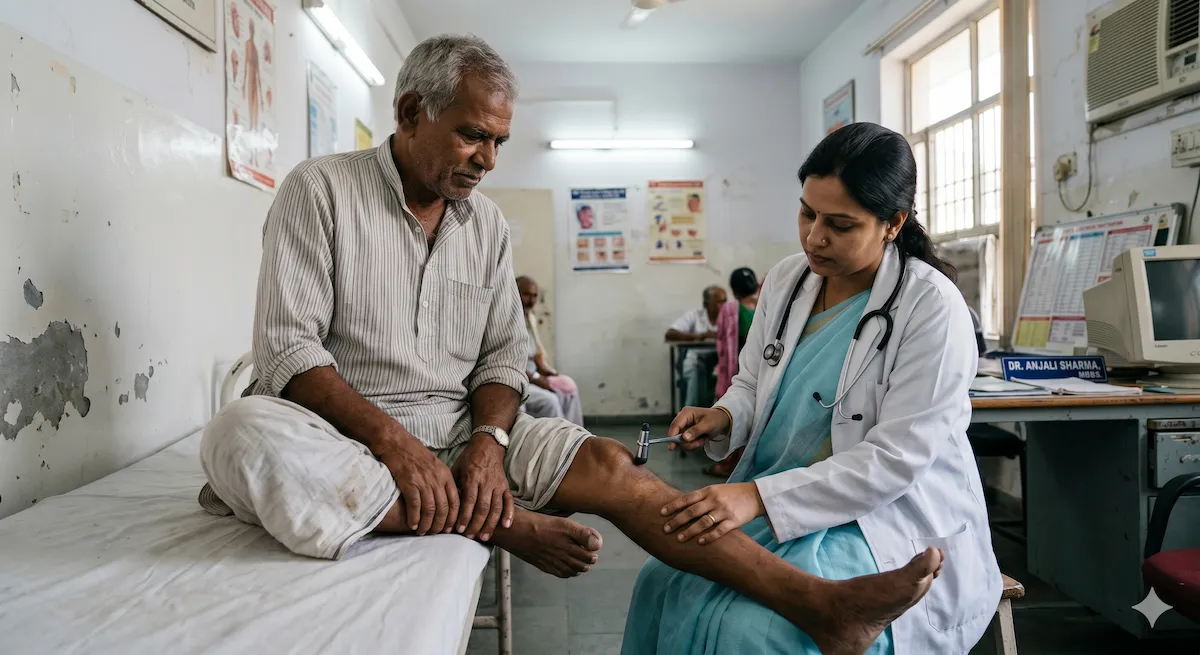
More than 60% of adults over 80 show signs of peripheral neuropathy on clinical screening yet most of them attribute the tingling in their feet and the unsteadiness in their gait to "old age." They are not imagining it. But they are misidentifying the cause. And that distinction matters enormously, because peripheral neuropathy is not just uncomfortable it is one of the leading, independently confirmed causes of falls in the elderly, a risk that stays hidden until the fall has already happened.
When "Pins and Needles" Gets Dismissed
In the world of Gurgaon high-rise living, a senior who says their feet feel numb or burning is often told the same thing: "Circulation problem hai, exercise karo." Or they are given a supplement and sent home. Sometimes the symptoms are attributed to the cold marble floors of their apartment. Sometimes to sitting too long.
What is rarely done and should be done first is a systematic neurological evaluation.
Peripheral neuropathy is damage to the network of nerves that runs outside the brain and spinal cord. It affects sensation, movement, and the body's ability to know where it is in space a function called proprioception. And while it affects roughly 2.4% of the general population, the prevalence rises to 8% in older populations. In very elderly adults those over 80 the numbers climb dramatically higher.
The reason it is so frequently missed is the same reason thyroid disease is missed, and for that matter, most silent conditions in seniors: its early symptoms look exactly like things we expect old age to produce. Numbness. Tingling. A slightly unsteady walk. Reduced sensitivity in the feet. Physicians and families alike interpret these as expected, not as diagnostic clues.
They are diagnostic clues. And failing to follow them up has consequences.
The Science: What Peripheral Neuropathy Actually Does
The peripheral nervous system is the body's wiring billions of nerve fibres connecting the brain and spinal cord to every muscle, organ, and patch of skin. These fibres carry two types of traffic: signals going out to muscles (motor signals) and signals coming back from the body's sensors (sensory and autonomic signals).
In peripheral neuropathy, these wires become damaged. The damage can be axonal i.e. where the nerve fibre itself degenerates or demyelinating, where the insulating sheath around the fibre (myelin) breaks down. Either way, signal transmission slows, distorts, or fails.
The consequences in older adults are threefold. First, the feet and lower limbs lose accurate sensation they may feel nothing, or paradoxically, they may burn or ache despite no external stimulus. Second, and more dangerously, the proprioceptive system breaks down. Proprioceptors are muscle and joint sensors that detect the body's position and movement in space and are essential for agonist-antagonist muscle synchronisation. Postural adjustments are made based on integrated visual, vestibular, and proprioceptive information and when the proprioceptive channel fails, the entire postural control system is compromised.
This is why a senior with peripheral neuropathy in their lower limbs cannot tell, in the dark, exactly where their feet are relative to the ground and why they stumble on uneven surfaces, kerbs, or even flat floors. The postural control of neuropathy patients is impaired through decreased sensory acuity, including impaired touch sensation and proprioception, and muscle strength and peripheral neuropathy has been confirmed as a risk factor for falls across multiple retrospective and prospective studies.
In a study specifically testing this causal link, no associated comorbidities explained the high rate of falls in elderly persons with peripheral neuropathy, confirming that peripheral neuropathy is a true, independent risk factor for falls not merely a marker for some other condition.
The Clinical Reality for Indian Seniors
For seniors, three causes of peripheral neuropathy are particularly relevant and particularly common.
Diabetes. India is now home to the second-largest diabetic population in the world. Diabetes mellitus accounts for approximately 30% of all peripheral neuropathy cases and in Indian seniors, many of whom have had type 2 diabetes for a decade or more, diabetic peripheral neuropathy is frequently already established by the time any formal neurological evaluation is done. The risk increases with the duration of poorly controlled blood sugar.
Vitamin B12 deficiency. This is the cause that is most underappreciated in the Indian context. A significant proportion of older Indians follow vegetarian or predominantly vegetarian diets and B12 is found almost exclusively in animal-sourced foods. A strict vegetarian diet promotes B12 deficiency because animal-based foods such as meat, dairy, fish, and eggs are the only recognised dietary sources of B12, and the inability of stomach acids to aid in absorption compounds this further. In ageing, gastric acid production naturally declines, making B12 absorption from food increasingly unreliable even in those who do consume animal products. Additionally, Indian seniors who have been on metformin for diabetes management face a compounded risk: long-term metformin use is a clinically documented cause of B12 depletion, and studies from Indian endocrinology centres confirm this association. B12 deficiency impairs the synthesis and repair of myelin sheaths the insulating layer around peripheral nerve fibres and defective myelin synthesis is directly linked to peripheral neuropathy.
Idiopathic causes. In 25–46% of all cases, peripheral neuropathy remains idiopathic no identifiable cause is found despite comprehensive workup. This does not mean treatment is impossible; it means the clinical focus shifts to symptom management and fall prevention.
There is a well-characterised ageing of the peripheral nervous system: a progressive decrease in sensory and motor nerve conduction velocity, reduced amplitudes of sensory potentials, abolition of ankle jerk reflexes, and alteration of proprioceptive sensitivity in almost two-thirds of individuals over 65 years old anomalies that tend to increase beyond the age of 80. Urban Indian seniors living in multi-storey buildings, navigating lift lobbies, parking basements, and marble-floored apartments, are exposed to fall environments daily. The combination of background age-related nerve changes and an additional neuropathic cause diabetes, B12 deficiency, or both creates a compounded vulnerability that is almost never discussed explicitly with families.
At Aamra Seniors Club, our structured day programme includes regular health monitoring, supervised movement sessions, and clinical oversight, giving families confidence that emerging conditions like peripheral neuropathy are not missed. Book a Day Pass and let us keep a closer eye on what matters.
Peripheral neuropathy in the feet dramatically increases the risk of undetected foot wounds. Diabetic seniors with neuropathy may sustain cuts, ulcers, or pressure injuries on the sole of the foot and feel nothing. Daily visual inspection of both feet by the senior or a caregiver is mandatory. Any wound, discolouration, or swelling in the foot of a diabetic senior with neuropathy must be assessed by a physician within 24 hours, not managed at home. Diabetic foot infections escalate rapidly and are a leading cause of lower limb amputation in India.