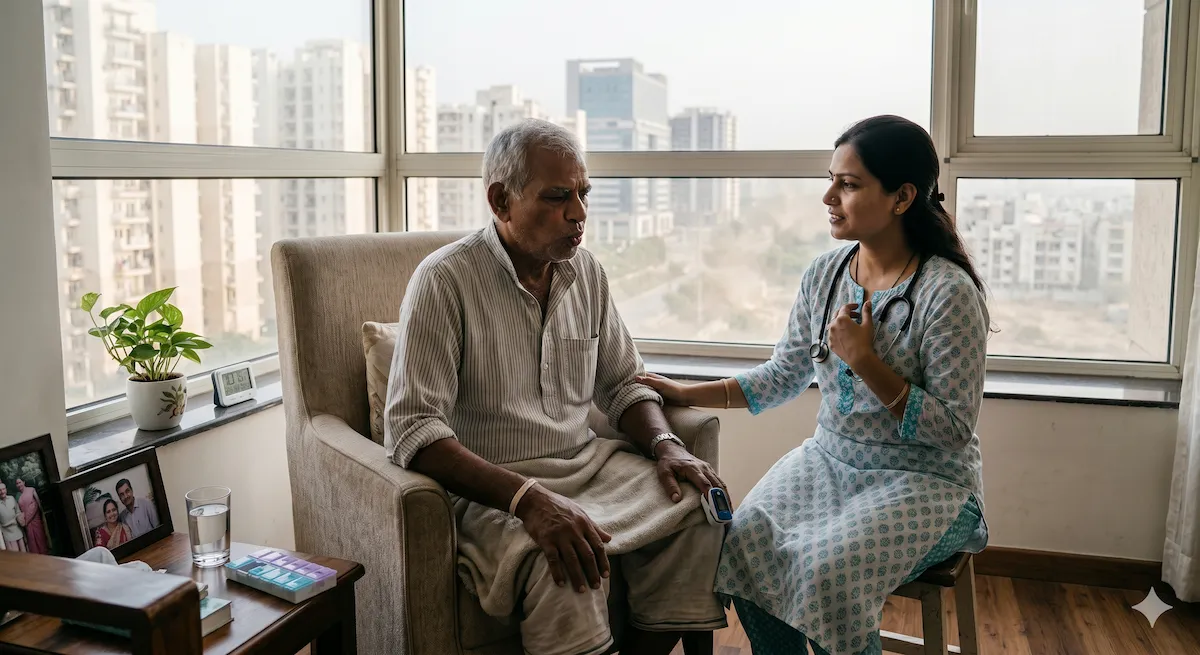
In India, the number of people living with COPD more than doubled between 1990 and 2016 from 28.1 million to 55.3 million. COPD contributes to 8.7% of total deaths and 4.8% of Disability Adjusted Life Years in India, ranking as the second most common cause of disease burden after coronary artery disease. Yet the majority of seniors living with it in Gurgaon high-rise apartments are managing their breathlessness alone, without a structured plan, without breathing technique training, and frequently with the wrong assumption that nothing can be done.
The Problem: Breathlessness Is Not Inevitable
When a 72-year-old retired man in a Gurgaon apartment pauses on the landing between floors to catch his breath, his family most likely says one of two things: "Papa ko saans ki takleef hai" and leaves it at that or "Doctor ne inhaler diya hai, theek hai."
Both responses miss the clinical reality. Breathlessness in COPD is not simply a consequence of disease severity that one must accept. It is a symptom that can be significantly reduced through specific, evidence-based home management techniques. Breathing exercises, including pursed-lip breathing, have been shown to reduce breathlessness measured on the modified Medical Research Council scale compared to usual care, and structured pulmonary rehabilitation changes daily function in measurable ways.
The problem is that most Indian families caring for a senior with COPD know about the inhaler. They rarely know about the breathing techniques, the pacing strategies, the exacerbation warning signs, or the environmental modifications that can keep a senior independent and comfortable at home for years longer than disease alone would predict.
The Science: What COPD Does to the Ageing Lung
COPD is not a single disease it is an umbrella term covering two overlapping pathologies: chronic obstructive bronchitis and emphysema. In both, the underlying driver is sustained inflammation of the airways and lung tissue, typically from years of cigarette smoke exposure, biomass fuel inhalation (a significant and underappreciated cause in Indian women who cooked over wood or coal), or chronic occupational dust exposure.
The defining feature of COPD is irreversible airflow limitation during forced expiration, caused by an increase in the resistance of the small conducting airways, emphysematous lung destruction, or both reliably reflected in two measurements: FEV1 (the volume of air expelled in one second) and the FEV1/FVC ratio.
At the cellular level, the inflammatory response during COPD exacerbations is characterised by elevated levels of IL-1β, IL-6, IL-8, and TNF-alpha cytokines that drive airway oedema, mucus hypersecretion, and progressive worsening of airflow limitation. Each exacerbation accelerates this inflammatory damage and leaves the lung with slightly less reserve than before. This is why preventing exacerbations is not just about comfort, it is about slowing the overall trajectory of the disease.
The ageing lung compounds this. After 60, lung elastic recoil naturally decreases, chest wall compliance changes, and respiratory muscle strength diminishes all of which narrow the functional reserve available to a person with existing COPD. When FEV1 falls below approximately 0.8 litres, patients are at risk of hypoxemia, hypercapnia, and cor pulmonale right heart failure driven by chronically low oxygen.
The breathlessness that results is not merely unpleasant. It triggers a vicious cycle: exertion causes breathlessness, breathlessness causes fear, fear causes avoidance of movement, avoidance leads to deconditioning, and deconditioning makes breathlessness worse even at lower levels of activity. Breaking this cycle is the central goal of COPD home management.
The Clinical Reality for Indian Seniors in Gurgaon
Gurgaon's air quality adds a clinically significant layer to this picture. Seasonal pollution spikes particularly between October and January directly trigger COPD exacerbations in vulnerable seniors. A Gurgaon resident with moderate COPD and a habit of morning walks along Golf Course Road in winter is absorbing particulate matter that inflames already damaged airways. The same resident's high-rise apartment, if poorly ventilated, may trap indoor pollutants at concentrations that exceed outdoor air.
There is also the underdiagnosis problem. Many senior women in urban Gurgaon with COPD were never heavy smokers, their lung damage came from decades of cooking in poorly ventilated kitchens using biomass or kerosene stoves. Their COPD is frequently attributed to "age-related lung changes" or dismissed because they don't fit the male smoker profile that most physicians still associate with the disease. By the time they present with significant breathlessness, they have already lost substantial lung function.
Finally, older age above 70 years is an independent factor associated with increased dyspnoea grade in COPD patients and moderate-to-severe breathlessness was observed even in 32% of patients with only mild airflow obstruction. Symptom severity does not always match spirometry numbers. A senior who describes significant breathlessness deserves clinical attention regardless of how mild their recent lung function test appeared.
Managing COPD Breathlessness at Home
1. Learn and practise pursed-lip breathing daily, it is a clinical intervention, not a relaxation technique
Pursed-lip breathing involves inhaling slowly through the nose and exhaling through pursed lips as if whistling taking twice as long to exhale as to inhale. By producing a proximal obstruction, the technique splints open the distal airways that have lost their tethering and would otherwise collapse during exhalation. Clinically, this reduces respiratory rate, increases tidal volume, and improves oxygen saturation. Practise for 10 minutes twice daily and deploy it immediately at any onset of breathlessness.
2. Use the forward-lean posture during breathlessness episodes
When breathlessness strikes, leaning forward with hands on knees or on a table the "tripod position" takes mechanical load off the respiratory muscles by fixing the shoulder girdle and allowing the accessory muscles of breathing to work more effectively. This is a simple, evidence-informed technique that can be taught to any senior at home and used during any acute dyspnoea episode.
3. Pace activities never rush
The COPD breathlessness cycle begins with rushed activity. Teach the senior to break tasks into small segments with rest intervals: walk to the kitchen, rest, then begin cooking. Dress in stages. Use a chair in the bathroom. The goal is to keep exertion within the range where breathing remains controlled. Activities that require sustained arm elevation like hanging clothes or reaching into high shelves are disproportionately breathlessness-inducing because they engage muscles otherwise used for breathing, and should be reorganised or delegated.
4. Monitor indoor air quality and manage exposure
Keep windows closed on high-AQI days and use a HEPA air purifier in the room where the senior spends most time. COPD patient education should include recognition of exacerbation triggers, medication adherence, and nutritional advice but environmental control is equally critical and often omitted. In Gurgaon's winters, an indoor AQI above 100 is a meaningful exacerbation risk for a senior with COPD.
5. Know the exacerbation warning signs and have a written action plan
An exacerbation is a sustained worsening of breathlessness, cough, or sputum beyond the patient's normal day-to-day variation. Families should know to act if: breathlessness worsens significantly over 24–48 hours; sputum colour changes from clear or white to yellow or green; SpO2 (measured on a home pulse oximeter) drops below 90%; or the senior is unable to complete a sentence without pausing for breath. A written action plan agreed in advance with the treating pulmonologist that specifies when to call the doctor and when to go to emergency, eliminates dangerous hesitation during an acute event.
6. Enrol in supervised pulmonary rehabilitation
Home-based pulmonary rehabilitation programmes that include controlled breathing technique training, graded exercise, and COPD education have demonstrated significant improvements in exercise capacity, breathlessness, and quality of life. In Gurgaon, this may take the form of a structured programme at a physiotherapy centre with pulmonary rehabilitation expertise, or a supervised group exercise and education programme. For seniors with moderate-to-severe COPD, this is not optional supplementary care, it is a primary clinical intervention.
Is your parent limiting activity because of breathlessness? At Aamra Seniors Club, our doctor-led day programme includes structured movement, supervised breathing exercises, and real-time health monitoring, so seniors with COPD stay active safely. Book a Day Pass.
A resting SpO2 below 88% in a COPD patient, or any episode where the senior is unable to speak in full sentences, is a medical emergency, call for emergency assistance immediately and do not wait. Also: many COPD patients in India are prescribed both a short-acting bronchodilator (SABA, for rescue) and a long-acting bronchodilator (LABA or LAMA, for maintenance). These are not interchangeable. Using the rescue inhaler as a daily maintenance medication leads to tolerance and reduces its effectiveness during genuine emergencies. If your parent is using their rescue inhaler more than twice a week, their COPD is undertreated and requires urgent review.
Doctor's Note
As an ENT surgeon, I see the upper airway, the larynx, the vocal cords, the upper trachea. But the respiratory system is one continuous tube, and I see daily how COPD affects the whole of it. What strikes me most in my interactions with senior patients in Gurgaon is the resignation. They have been told they have a chronic disease, they have been given an inhaler, and they have accepted breathlessness as a fixed feature of their life. It is not. I have seen patients who have genuinely improved their daily function through consistent breathing technique training and graded activity, not because their lung disease reversed, but because they learned to use the lung capacity they still have more efficiently. The breathlessness your parent experiences when climbing from the car park to the apartment is not just COPD it is also deconditioning, poor breathing mechanics, and possibly preventable exacerbations. All three are addressable. Please do not let them stop moving entirely. That is the one thing guaranteed to make things worse.