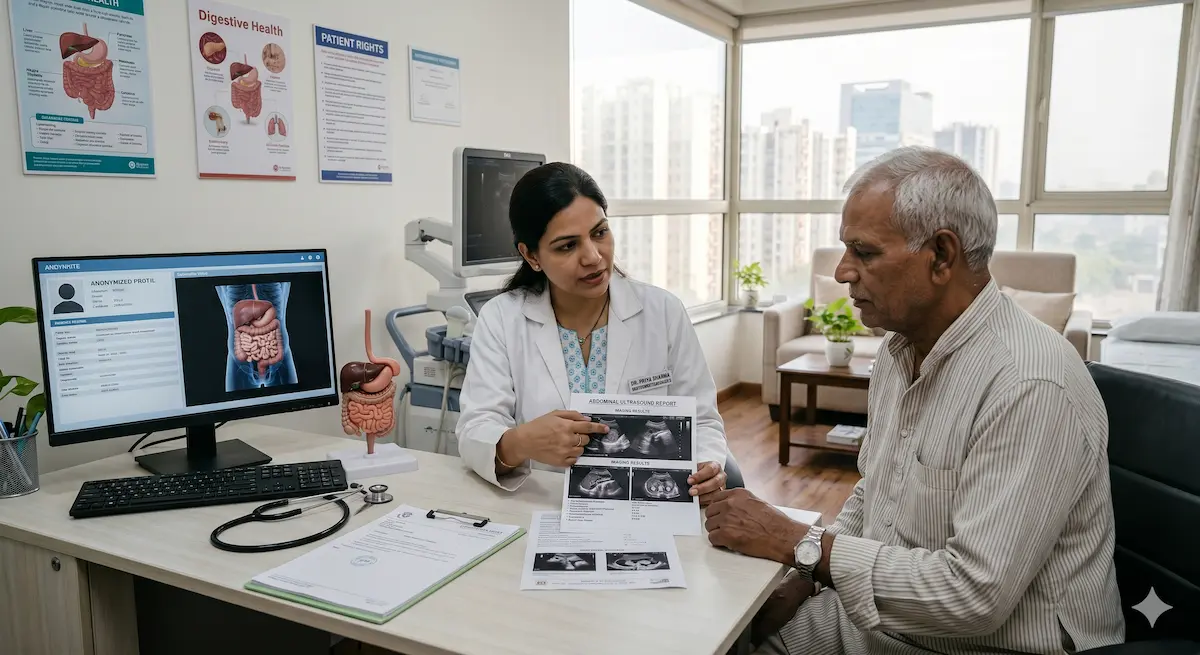

Roughly one in three Indian adults has non-alcoholic fatty liver disease, a condition with no connection to alcohol consumption at all. A systematic review and meta-analysis of Indian population data estimated the pooled prevalence of NAFLD among adults at 38.6%, meaning available data suggest that approximately one in three adults in India have NAFLD. Among seniors specifically, the numbers are even higher, and the condition is almost always silent until it isn't.
The Problem: "It's Just Fatty Liver, Doctor Said Don't Worry"
This is one of the most common sentences I hear from families. A senior gets an abdominal ultrasound for an unrelated reason, perhaps to investigate vague abdominal discomfort, and the report mentions "mild fatty infiltration of the liver." The doctor, often rushed, says something reassuring: it's common, it's mild, don't worry about it.
What rarely gets communicated is that fatty liver is not a static, harmless finding. It is the visible marker of an active metabolic process, one that, left unaddressed, can progress over years toward inflammation, scarring, and in a meaningful minority of cases, cirrhosis. NAFLD pathology ranges from simple steatosis to a necroinflammatory fibrosing disorder called steatohepatitis, which is associated with high risk of developing cirrhosis, often occurring specifically in the seventh to ninth decades of life, meaning the seniors most at risk are exactly the population being told not to worry.
The "mild fatty liver, don't worry" conversation is not wrong about today. It is incomplete about tomorrow.
The Science: Why Fat Accumulates in the Ageing Liver
NAFLD begins with a breakdown in how the body manages fat and sugar together, a process centred on insulin resistance.
Under normal conditions, insulin signals fat cells to store fat and signals the liver to manage glucose appropriately. When insulin resistance develops, as it does progressively with age, particularly with central obesity and reduced muscle mass, this signalling breaks down. Insulin resistance disrupts normal lipolysis and exacerbates de novo lipogenesis (the liver's own fat-production process), exceeding the liver's metabolic capacity and generating lipotoxic species that induce oxidative stress, activate inflammatory pathways, and cause hepatocyte cell death.
In practical terms: fat cells that should be storing fat release it into the bloodstream instead, and the liver, overwhelmed, starts accumulating that fat internally rather than processing it. Insulin resistance allows inappropriately sustained lipolysis with release of free fatty acids, which are then shunted to the liver at times when the liver is programmed for fat production rather than fat disposal, and insulin resistance is found in virtually every patient with steatohepatitis and in approximately 60% of all NAFLD patients.
Ageing intensifies this process through liver-specific mechanisms as well. The incidence of fatty liver in people older than 60 is roughly twofold greater than in people aged 20–40, and individuals in Asian cohorts who are older than 60 are more prone to severe NAFLD, including fibrosis, compared to those under 60. Recent research has identified specific cellular mechanisms behind this, including reduced lipophagy, the process by which liver cells break down and clear stored fat internally, which appears to decline with age and contributes directly to fat accumulation.
This is the mechanism families are rarely told about: fatty liver in a senior is not the same biological process, with the same trajectory, as fatty liver in a 35-year-old. The ageing liver has reduced capacity to clear the fat it accumulates.
The Clinical Reality for Indian Seniors
For seniors in Gurgaon's DLF Phase 1 and surrounding sectors, the risk factor profile for NAFLD overlaps almost completely with the risk factor profile that's already common in this population: type 2 diabetes, central obesity, sedentary lifestyle following retirement, and a dietary pattern often heavy in refined carbohydrates relative to fibre and protein.
Epidemiological studies suggest NAFLD prevalence ranges from 9% to 32% across the general Indian population, with markedly higher prevalence in those who are overweight or have diabetes or prediabetes, and nearly half of Indian NAFLD patients have evidence of full-blown metabolic syndrome. Given how common type 2 diabetes already is among urban Indian seniors, this overlap means a substantial proportion of seniors managed for diabetes alone are simultaneously living with unaddressed, and often unmentioned, liver disease.
A study from urban Delhi found something particularly relevant to Gurgaon's demographic: the age- and sex-standardised prevalence of ultrasound-diagnosed NAFLD in an urban Delhi population was 65.7%, substantially higher than the rural comparison population, with diabetes, central obesity, and insulin resistance significantly associated with the condition in both settings. Urban Indian seniors, with their particular combination of dietary patterns, reduced physical activity in high-rise living, and high diabetes prevalence, sit squarely in the highest-risk category this research describes.
If your parent's recent health check mentioned fatty liver, our doctor-led day programme at Aamra Seniors Club includes structured metabolic monitoring and nutrition guidance tailored for seniors. Book a Day Pass.
Never assume a "fatty liver" finding excludes more serious liver disease. If liver function tests show persistently elevated ALT or AST, or if a FibroScan indicates significant liver stiffness, this requires referral to a hepatologist for further evaluation, not repeat reassurance at the next annual check-up. Untreated steatohepatitis can progress silently to cirrhosis over years, and by the time symptoms like jaundice or abdominal swelling appear, the disease is often already advanced.
Doctor's Note
Fatty liver is one of those diagnoses that gets handed to patients almost casually, as an incidental finding, delivered with reassurance, and then largely forgotten. I understand why: in isolation, simple steatosis often does remain stable for years. But what I want families in Gurgaon to understand is that "fatty liver" in a senior, especially one with diabetes or central obesity, is rarely an isolated liver problem. It is a visible signal of metabolic dysfunction happening throughout the body, in the pancreas, the fat tissue, the blood vessels. When I see this finding in an elderly patient's report, my first question is never about the liver in isolation. It's about everything connected to it. If your parent has been told they have fatty liver and nothing more was said, it is entirely reasonable to ask for that fuller metabolic picture. The liver is rarely working alone.