The Man Who Couldn't Retire
A 68-year-old banker retired from his corporate job in 2019. Excellent pension, time freedom, the whole package that's supposed to be the dream. For three months, it was. Then something shifted.
He told his wife: I feel like I'm disappearing.
He wasn't depressed in the clinical sense. He had hobbies, family, financial security. But the structure that had defined his identity for 40 years had vanished. The decisions that mattered, the problems he solved, the expertise people sought him for all gone. He was suddenly without purpose.
By month four of retirement, he'd lost weight, his blood pressure had risen, he slept poorly, and he'd developed a tremor in his hands. His physician ran every test imaginable. Everything was normal. The only thing that had changed was his life structure.
Then, at a coffee with a younger friend struggling with a business, he started advising. Casually at first, then more seriously. The friend incorporated his ideas. The business grew. Suddenly, the banker was no longer retired he was a consultant, an advisor, a mentor. His expertise had a home again.
Within six months, his tremor resolved. His weight stabilised. His blood pressure normalised. His sleep improved. His physician asked what medication he'd changed. The answer was: nothing. Everything had changed because his purpose had returned.
Why Gurgaon's Retirement Culture Is Backwards
Gurgaon sells retirement as freedom from work. The implicit narrative: you work for 40 years, then you stop working, and you live happily ever after.
This narrative is clinically backwards.
Purpose is not a luxury that makes life pleasant. Purpose is a biological variable that affects health outcomes as much as diet, exercise, or sleep. A senior without purpose doesn't just feel empty their physiology changes in measurable, harmful ways.
Here's what happens when purpose disappears:
Inflammatory markers rise: Cortisol stays elevated. IL-6 and TNF-alpha (inflammatory cytokines) increase. The body enters a state of chronic stress even though nothing externally has changed.
Immune function declines: Purposelessness suppresses NK (natural killer) cell activity and T-cell function. Infections become more common. Recovery from illness slows.
Cardiovascular risk increases: Blood pressure rises, even in previously normotensive seniors. Resting heart rate increases. Atherosclerosis progression accelerates.
Cognitive decline accelerates: The brain, deprived of novel stimulation and meaningful problem-solving, shows measurable cognitive aging.
Mortality increases: Multiple studies show that purposeless retirement is associated with earlier mortality, even controlling for age, health status, and baseline function.
Purpose is not sentiment. Purpose is physiology.
Gurgaon's culture offers seniors two options: keep working in the job that's exhausting you, or retire into emptiness. There's a third option that almost no one discusses: the encore career work that's chosen for meaning, not money; scaled for energy, not ego; structured around purpose, not pressure.
The Clinical Evidence: Why Purpose Extends Healthspan
Research in gerontology consistently points to a pattern: seniors with strong sense of purpose show better health outcomes across multiple domains than those without. The exact mechanisms and magnitudes vary by study, but the direction is clear.
The General Research Pattern:
Purposefulness appears to correlate with improvements across several health dimensions:
Longevity: Seniors with high sense of purpose tend to have longer lifespans, though the magnitude varies by population and how purpose is measured.
Cardiovascular Health: Purpose correlates with better cardiovascular outcomes lower blood pressure, fewer cardiac events, better recovery. This may operate through reduced chronic stress and inflammation.
Cognitive Function: Meaningful engagement and purposefulness appear protective against cognitive decline, likely through ongoing neuroplasticity, the brain continues to build new connections when challenged.
Inflammatory Status: Chronic purposelessness associates with elevated inflammatory markers. Purpose-driven engagement appears to moderate these inflammatory pathways.
Mental Health: Depression incidence is notably higher in seniors without purpose than in those with meaningful engagement.
The schematic pattern across this research is that purpose operates as a biological variable, not merely a psychological one. The body appears to respond to meaningful engagement by maintaining itself better. Whether through work, volunteering, mentoring, or community involvement, purposeful activity shows protective effects.
Important caveat: The research clearly shows purpose is associated with better outcomes. The specific magnitudes of these effects, the mechanisms of causation, and which types of purpose are most protective remain active areas of gerontology research. The findings are directionally consistent but not yet precisely quantified across populations.
What Is an Encore Career?
An encore career is not a second job. It's not about needing money (though income can be part of it). An encore career is:
Chosen for meaning, not necessity: You're doing it because it matters to you, not because you have to.
Scaled for energy: It's not all-consuming. It fits into a life that includes rest, family, and leisure.
Built on expertise: You're using knowledge accumulated over decades in a way that serves others or solves a problem.
Generating purpose: It answers the question: Why do I get out of bed? with something beyond because I should.
Examples in the Gurgaon context:
A retired accountant mentoring startups in financial management.
A retired architect consulting on community development projects.
A retired teacher tutoring underprivileged students.
A retired executive advising younger entrepreneurs.
A retired engineer designing solutions for social enterprises.
A retired marketer building a niche personal brand or consulting practice.
A retired administrator organising community initiatives.
The common thread: Expertise applied to something that matters.
The Silver Economy: The Gurgaon Opportunity
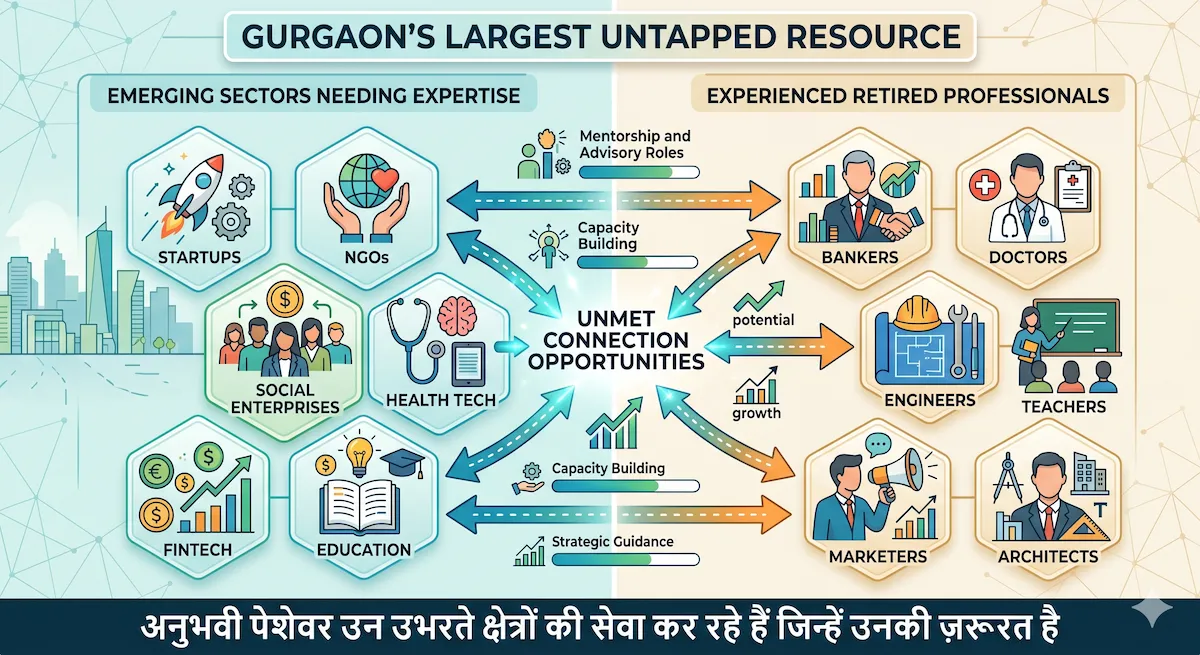
Gurgaon hasn't noticed yet, but there's an emerging silver economy a market built around the skills, experience, and consumption needs of 60+ year-olds. And it's largely underserved by people who actually understand the demographic.
Who better to advise a fintech startup on user experience for older adults than a retired banker who understands both finance and aging?
Who better to consult on health tech for seniors than a retired physician?
Who better to mentor young entrepreneurs on resilience and business fundamentals than someone who's navigated 40 years of corporate life?
Gurgaon has thousands of retired professionals with deep expertise sitting in apartments, feeling purposeless, watching their health decline. Simultaneously, the silver economy is growing startups, NGOs, social enterprises all trying to serve seniors without actually understanding them.
The match is obvious. The infrastructure to enable it is absent.
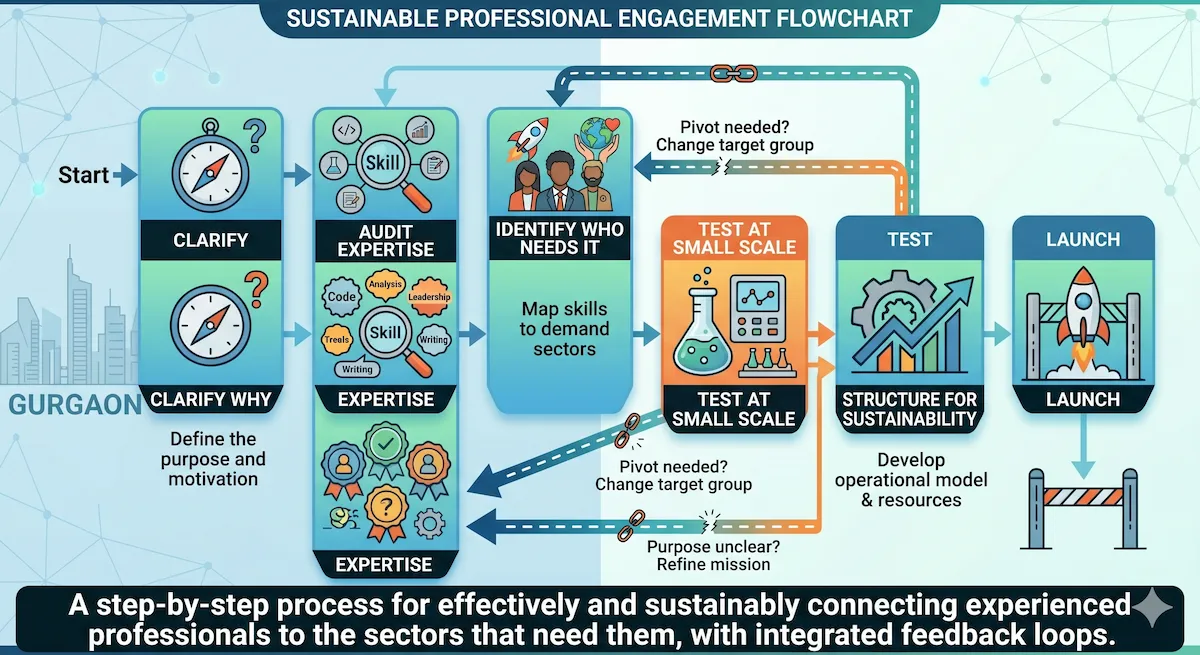
The Gurgaon Framework: Building an Encore Career
Here's a practical structure for pursuing meaningful post-retirement work:
Step 1: Clarify the Why (Not the What)
Before identifying what to do, get clear on why you want to do something:
Is it income? (If yes, how much?)
Is it purpose and identity? (If yes, what kind of impact matters?)
Is it social engagement? (If yes, what type of community?)
Is it intellectual engagement? (If yes, what kind of problems?)
Is it all of the above?
The why determines the structure of the what.
Step 2: Audit Your Expertise Honestly
What do you actually know well? Not what you think you should know, but what decades of experience have taught you?
What problems have you solved repeatedly?
What decisions have you made?
What do people ask you for advice on?
What do you know that's genuinely rare and valuable?
This is your asset. This is what you can offer.
Step 3: Identify Who Needs It
Who benefits from your expertise?
Startups needing business guidance?
Students needing mentoring?
NGOs needing strategic advice?
Younger professionals needing career coaching?
Your community needing problem-solving?
The who determines the structure and commitment level.
Step 4: Start Small and Test
Don't commit to a major role immediately. Volunteer, consult, advise on a small scale first. See if it energises you or drains you. See if the fit is real.
A retired banker might mentor one startup founder for three months before committing to a consulting practice. A retired teacher might tutor one student before launching a tutoring service.
Step 5: Structure for Sustainability
An encore career should fit into a life that includes rest, family, and leisure. The structure might look like:
10-15 hours/week of meaningful work
Flexible timing (not rigid corporate schedules)
Income that supplements, not determines, lifestyle
Clear boundaries (when you're off, you're off)
This is different from employment. This is chosen work.
Step 6: Make It Social
The best encore careers build community. Mentoring a startup founder isn't just about advice, it's about relationship. Teaching builds community with students. Volunteering on a board connects you to peers.
Purpose plus community is where healthspan really extends.
Closing remarks
Your parent spent 40 years building expertise in something. That knowledge doesn't expire at retirement. Neither does their capacity to contribute.
Gurgaon's retirement narrative work hard, stop working, enjoy life misses something fundamental: humans are built for purpose. We age gracefully when we have reasons to stay engaged. We decline rapidly when purpose vanishes.
The encore career isn't about money or staying busy. It's about using what you know to serve something that matters. It's about the banker mentoring a startup founder and feeling, for the first time in years, that his experience has a home. It's about the retired teacher tutoring a student and rediscovering the joy of teaching without the burnout of the institution. It's about the retired engineer designing solutions for a social enterprise and feeling that their problem-solving mind still matters.
This is where purpose lives: not in games or hobbies, but in work that's chosen for meaning and scaled for life.
The silver economy is real. Gurgaon's senior professionals are sitting on decades of expertise that emerging sectors desperately need. The connection just hasn't been made yet.
If your parent is struggling with retirement, the answer might not be a hobby or a crossword. The answer might be: What expertise do you have that the world actually needs?
When Purpose Becomes Obsession
Not all work is healthy work. Some encore careers can replicate the same burnout patterns that made corporate work exhausting.
If your parent (or you) is considering an encore career, watch for these warning signs that purpose is becoming pathology:
Time Creep: The project that was supposed to be 10 hours/week is now 25+ hours/week, with the same justification: This work is important.
Financial Pressure: The work that was supposed to be meaningful is now creating financial dependency. Suddenly, they have to continue because money's involved.
Identity Fusion: Their entire sense of self becomes the work. Without it, they feel worthless. This is not purpose; this is fragility.
Relationship Erosion: The work takes priority over family, health, or rest. Partners complain they've lost them to the new project.
Physical Neglect: Sleep suffers, meals become irregular, exercise stops. The work's urgency overrides basic self-care.
Inability to Scale Back: When asked to reduce hours or intensity, they can't. The answer is always yes to new requests, new projects, new demands.
Anxiety When Not Working: They feel restless, anxious, or empty when not engaged in the work. This is not purpose; this is addiction.
Purpose should add to life, not consume it. If an encore career is replicating corporate burnout in a different wrapper, it's not serving healthspan.
FAQs
My parent says they don't know what they'd be good at in a second career. How do they figure it out?
What if my parent wants to pursue an encore career but worries about competing with younger professionals?
Is pursuing an encore career financially viable, or is it a luxury for wealthy retirees?