A Clinical Confession
I spent the first decade of my medical career doing what I was trained to do: eliminate disease. Head and neck cancers, thyroid pathology, chronic sinusitis, voice disorders each patient who walked into my practice represented a problem with a surgical solution. I was good at it. The data backed it up successful resections, restored swallowing function, reconstructed airways, patients who could speak and eat again after I'd intervened.
Then I noticed something that no textbook prepared me for: some of my most successful surgical cases had the worst psychological outcomes. And some patients who came to me with minor complaints a hoarse voice, a throat tickle, a small nodule weren't really coming about the symptom at all.
They were coming to talk.
Not in a casual way. They were coming because, in a city like Gurgaon where isolation is the default setting, an appointment with a doctor was sometimes the only structured conversation they had all week.
The Patient Who Wasn't Sick
A 68-year-old woman came to my clinic with a complaint of voice hoarseness lasting three weeks. I did the workup laryngoscopy, imaging, voice assessment. Everything came back normal. There was no pathology. The vocal cords were fine. No nodules, no inflammation, no cancer.
But she kept coming back.
Not with new symptoms the hoarseness had resolved spontaneously but with variations on the same concern. Is it coming back? Could it be something serious? Can I come in again next week just to check?
I could have dismissed this as health anxiety. In a younger patient, I probably would have. But this woman lived alone in a sector 43 high-rise, had lost her husband two years prior, was retired from a job that had structured her days, and had no daily contact with peers.
During one appointment, I asked her directly: The voice seems fine. What's really going on?
She cried. She said: I just needed someone to listen to me. At home, there's no one. My children call from abroad, but they're busy. The building is full of people, but I know no one. When I come here, someone pays attention.
The hoarseness was real, but it wasn't the problem. The isolation was.
Why This Matters for an ENT Surgeon
This might seem tangential to head and neck surgery. It's not. Here's what I've observed in my practice over the past five years:
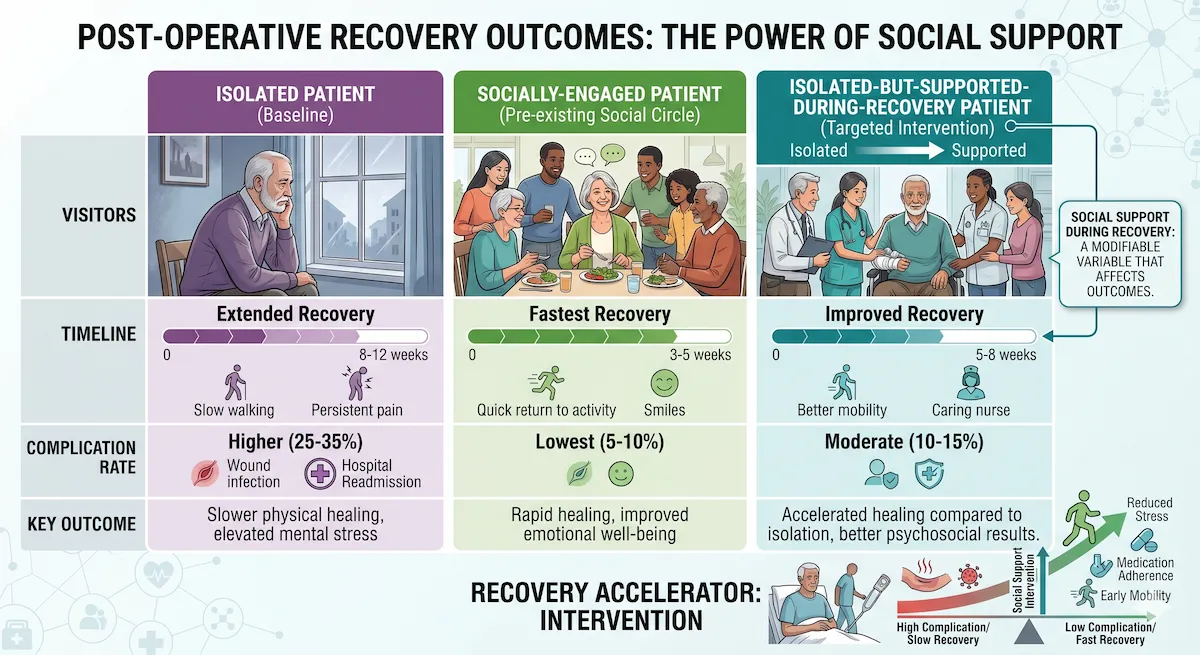
Post-operative outcomes are dramatically better in socially engaged patients. I've operated on two men with laryngeal cancer similar stage, similar treatment, similar surgical technique. One had an active social life, a strong marriage, caring daughters & peer engagement. The other was recently retired, living alone, without community.
The socially engaged patient recovered faster, complied with speech therapy diligently, returned to social activities within weeks, and reported high quality of life post-surgery despite permanent voice changes.
The isolated patient struggled with depression post-operatively, delayed rehabilitation, experienced greater voice-related disability despite identical surgical outcomes, and socially withdrew further.
Same surgery. Different result. The variable wasn't surgical skill it was life context.
I began tracking this informally. Patients who reported strong social engagement pre-operatively:
Showed better wound healing
Had lower post-operative infection rates
Reported better pain management
Adhered to rehabilitation protocols
Had superior long-term functional outcomes
Patients who were isolated pre-operatively experienced opposite patterns not because they received worse surgery, but because post-operative recovery happened in a social vacuum where motivation, immune function, and psychological resilience were all compromised.
The Gurgaon-Specific Reality: Isolation as a Clinical Risk Factor
Gurgaon presents a peculiar health problem that surgery cannot solve: structured isolation.
Your parent lives in a high-rise with 500 other people and knows none of them. They have access to world-class medical care they can get imaging, surgery, medication within 24 hours. But they have no access to the one thing that genuinely predicts health outcomes: consistent, meaningful human connection.
As an ENT surgeon, I see this manifest in three specific ways:
1. Patients Who Come to Complain, Not Because They're Sick
My clinic sees a surprising number of patients with minor or resolved symptoms who request frequent follow-ups. A voice change that's already resolved. A throat sensation that's benign. A swallow concern that imaging shows is normal.
In 80% of these cases, when I actually listen (not just diagnose), the person is isolated. They come because the appointment structure gives them a reason to leave home, to interact with a healthcare provider, to feel attended to.
This isn't malingering. This is a rational response to social deprivation. They've found a socially acceptable way to access human attention.
2. Patients Who Delay Necessary Care Because They Have No Social Pressure
Conversely, I see patients with genuine pathology a thyroid nodule requiring biopsy, a concerning laryngeal lesion who refuse or delay care. Often, when I ask why, it's because there's no one depending on them to be healthy. No grandchild saying Dadi, please get that checked. No spouse saying We need to know. No peer group saying Let's get you sorted.
In isolation, the incentive structure for health maintenance collapses.
3. Post-Operative Complications Are More Severe in Isolated Patients
I've operated on patients post-cancer who are socially engaged they have people visiting, people checking on them, people motivating them through swallowing rehabilitation and voice therapy. They recover remarkably well.
I've operated on patients post-cancer who are isolated, they're alone at home, managing their own wound care, doing rehabilitation exercises with no one to push them through the difficulty. They develop complications at higher rates. Their functional outcomes are worse. Their psychological burden is heavier.
Same cancer. Same surgery. Different outcome entirely based on the presence or absence of social structure.
The Pivot: From Surgery to Understanding Why People Come
About five years ago, I started asking different questions in my clinic.
Instead of just: What is the pathology? I began asking: What is this person's life like? Who's in it? What brings them engagement?
I noticed that patients weren't always coming for diagnosis. Sometimes they were coming for presence.
This changed how I practice. I still do surgery. But now, before I operate on someone particularly someone isolated I ask:
Who will support this person during recovery?
What is this surgery enabling them to do?
Patients may think that I ask a lot of unrelated questions, but I know these are important.
What This Looks Like in Practice
Here's how my approach has changed:
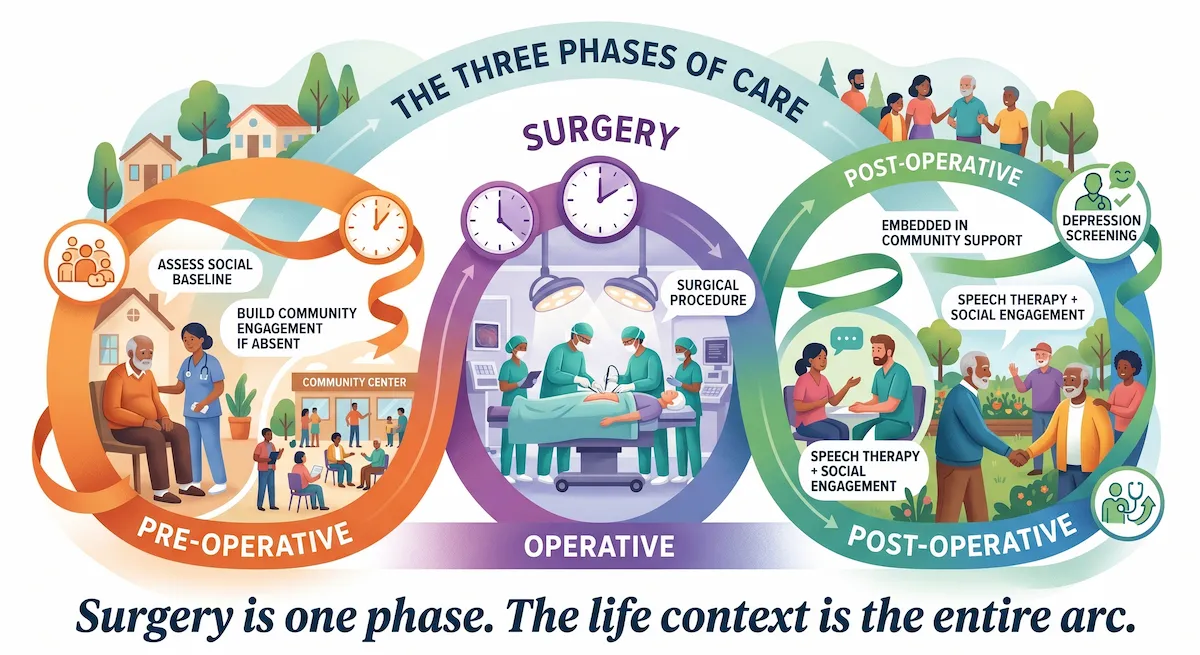
Pre-Operative Assessment Now Includes:
Social baseline: Who is this person connected to?
Purpose clarity: Why does restoration of function matter to them?
Support structure: Who will be present during recovery?
Community engagement: Are they part of any peer groups or structured community?
For Isolated Patients, Pre-Operative Phase Now Includes:
Enrolment in peer community before surgery
Family coordination (if NRI children, establishing a care plan that includes emotional support, not just logistics)
Setting expectations about recovery requiring social engagement
Post-Operative Care Now Explicitly Includes:
Ensuring the patient has consistent engaged support, not just attendant-based supervision
Speech therapy + social engagement together (swallowing rehabilitation is easier with peer support)
Monitoring for post-operative depression (very common in patients; should be anticipated and addressed)
Connecting patients to ongoing community so recovery has purpose
The Closing Frame
I still operate. When the pathology is real and the patient is ready, I trust my training and my hands. But I've learned that the surgery itself is only one phase of a much longer arc: diagnosis, preparation, surgical intervention, recovery, rehabilitation, and reintegration into life.
The surgery can be perfect, and the outcome can still be poor if the recovery happens in isolation. Conversely, a good-but-not-perfect surgery can have excellent outcomes if the patient recovers embedded in community, with people invested in their healing.
Your parent doesn't just need a surgeon who can fix the pathology. They need a care system that ensures recovery happens in context with support, with purpose, with people.
Some of my most important work happens not in the operating room, but in referring a patient to a day club, or connecting an isolated senior to peers, or ensuring that a family understands that post-operative depression is real and predictable in isolated patients.
This isn't medicine beyond surgery. It's surgery understood completely not just the technical aspects, but the human ones.
The Surgery You Might Not Need
As an ENT surgeon, I'm trained to intervene. But I've learned to recognize when intervention isn't the answer:
Do not proceed with elective head and neck surgery if your parent meets all three of these criteria:
Isolated: Lives alone, minimal daily social contact, no structured peer engagement, limited family proximity.
No Clear Post-Op Support: During recovery (which requires dietary modifications, speech therapy, possible feeding tube management, wound care), there's no committed, engaged person present consistently.
Age 75+ with Multiple Comorbidities: The surgery itself becomes riskier, recovery becomes slower, and the window for meaningful functional restoration narrows.
What to do instead: Delay elective surgery. Use that time to build engagement and family support structure. Then reassess whether surgery still makes sense, and if it does, proceed with the patient supported rather than isolated.
FAQs
As an ENT surgeon, why are you talking about social engagement instead of focusing on surgical technique?
How do I know if my parent's symptoms are real or just isolation?
Are you suggesting people shouldn't have surgery if they're lonely?