The Forgotten Name at the Dinner Table
A common scene in Gurgaon apartments, particularly during weekend family visits: Your mother pauses mid-sentence, searching for her daughter's colleague's name. What's his name... the one who works in tech? She knows she knows it. It's there, somewhere. Twenty seconds later, it comes: Rahul, yes, Rahul.
Everyone at the table relaxes. Nervous laughter. Mom's getting forgetful, someone jokes.
But here's what I've observed clinically: that moment tells you almost nothing about whether your mother is experiencing normal aging or early cognitive decline. The forgotten name could be either. And the distinction matters urgently, because one is benign and the other is a window for intervention.
The problem is that we've been taught to treat all memory lapses as equal. They're not. A 68-year-old forgetting a name she hasn't heard in months is normal. A 68-year-old forgetting her daughter's name is not. A 72-year-old misplacing her keys is normal. A 72-year-old forgetting what keys are for is not.
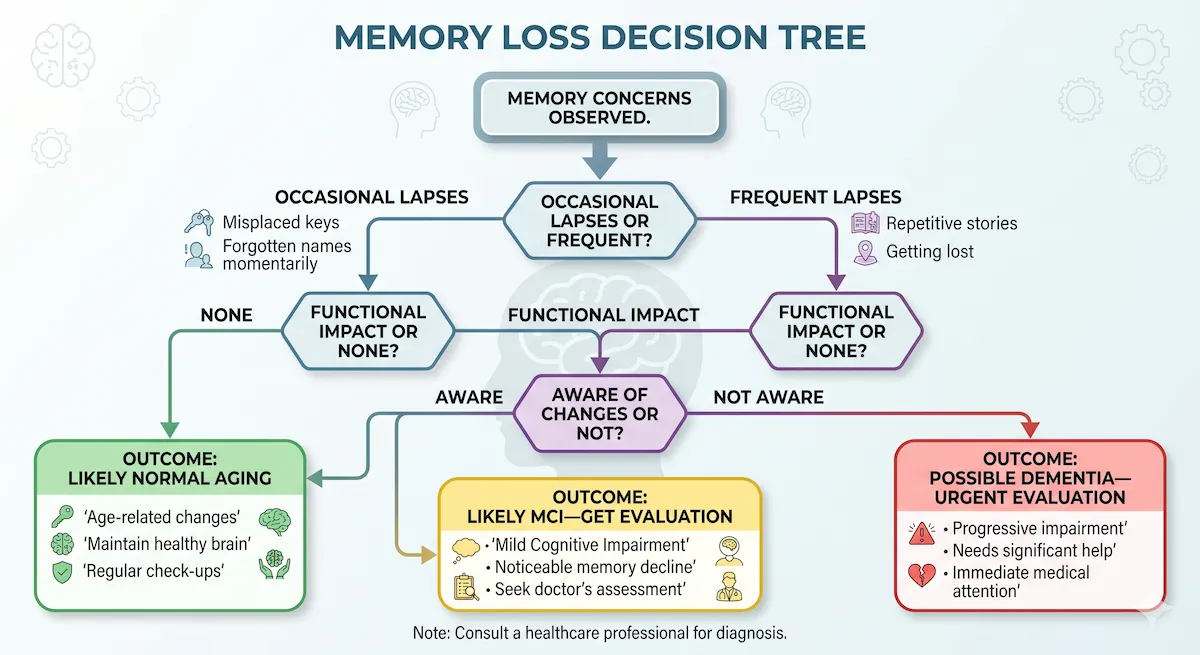
The difference between normal aging and early mild cognitive impairment (MCI) is not in whether memory lapses happen. It's in the pattern, frequency, severity, and impact on daily function.
Learning to distinguish them could mean the difference between reassurance and early intervention and early intervention, for cognitive decline, is where prevention actually works.
Why Gurgaon Makes This Distinction Harder
Gurgaon's high-rise isolation amplifies cognitive anxiety. Your parent lives surrounded by people but without the daily social friction that would normally reveal cognitive changes. They're not navigating a neighbourhood where a shopkeeper would notice if they seemed confused. They're not managing a job where colleagues would flag if they'd become forgetful. They're not in a joint family where daily interaction would catch subtle shifts.
Instead, they're in a one-bedroom flat, seeing you (if NRI) every 6-8 weeks, interacting primarily with an attendant who may not know what normal looks like for them.
This creates a blind spot: Cognitive changes happen silently, and by the time family notices, the decline may be further along than it needs to be.
Additionally, Gurgaon's medical culture tends toward extremes: either Everything's fine, this is just aging or Your parent might have dementia, get a brain scan. There's little middle ground where early detection and prevention live.
The Distinction: Normal Aging vs. Mild Cognitive Impairment (MCI) vs. Dementia
This table is the clinical framework I use to help families understand what they're observing:
Dimension | Normal Age-Related Memory | Mild Cognitive Impairment (MCI) | Dementia (Early Stage) |
|---|---|---|---|
Type of Memory Loss | Occasional lapses in non-essential details (names, dates, where keys are) | Noticeable decline in memory for events, conversations, recent information | Significant loss of recent memory, difficulty retaining new information |
Frequency | Occasional, situational | Frequent, happening multiple times per week | Daily, pervasive across all contexts |
Impact on Daily Function | None; person compensates easily or forgets the forgetting | Noticeable impact; requires increased effort or external aids (lists, reminders, written notes) | Significant impact; daily activities become difficult (cooking, managing finances, self-care) |
Awareness of Decline | Fully aware; can laugh about it | Aware and concerned; often seeks reassurance | Often unaware; may deny or minimise changes |
Long-Term Memory (distant past) | Intact; can recall childhood, historical events, life stories | Intact; early events remembered normally | May be affected; struggles with biographical information |
Repetition of Stories/Questions | Rare; occasional repeat of a story months apart | More frequent; may repeat within days or weeks | Very frequent; may repeat same conversation within hours |
Getting Lost or Disoriented | Never, in familiar locations | Occasionally in unfamiliar places; may get confused about dates/times | Can get lost in familiar locations; time disorientation is common |
Management of Complex Tasks | Manages finances, medications, appointments without issue | May need help organising complex tasks; benefits from written systems | Cannot manage finances, medications safely; requires supervision |
Social and Hobbies | Maintains interests and social engagement | Generally maintains, but may withdraw if tasks become cognitively demanding | Often loses interest; withdrawal from previously enjoyed activities |
Conversation Quality | Word-finding pauses (tip-of-tongue) but complete thoughts | Occasional word-finding difficulty; may lose thread of conversation | Frequent difficulty finding words; conversations become repetitive or difficult to follow |
Timeline | Stable over years | Decline noticeable over months to 1-2 years | Progressive; noticeable change month-to-month |
Reversibility | N/A; this is normal | Partially reversible with intervention (addressing sleep, depression, medication side effects, cognitive engagement) | Largely irreversible; progression can be slowed with early treatment |
Why Early Detection Matters
Here's where urgency enters the picture: MCI is the intervention window.
MCI is not dementia. Many people with MCI never progress to dementia. But MCI is abnormal aging. It's a measurable decline beyond what's expected. And crucially, early intervention cognitive engagement, cardiovascular health optimisation, treatment of depression or sleep issues can slow or even reverse MCI.
Once dementia develops, intervention is about slowing decline, not reversing it. The window for meaningful prevention has often closed.
This is why the distinction matters: A 70-year-old who occasionally forgets names (normal aging) doesn't need intervention reassurance is appropriate. A 70-year-old who's noticeably more forgetful than last year, struggling to manage familiar tasks, requiring lists for everything, and unaware that anything's changed (MCI) that person needs evaluation and intervention now.
The difference in outcome is years of cognitive function.
The Neurobiology: Why Cognitive Decline Happens (And Why Early Intervention Works)
Understanding the mechanism helps you understand why timing matters.
Cognitive decline in aging happens through several overlapping processes:
1. Neuro-inflammation: Aging triggers persistent low-grade inflammation in the brain, particularly in regions governing memory (the hippocampus) and executive function (the prefrontal cortex). This inflammation accelerates cognitive aging.
2. Accumulation of Pathological Proteins: Amyloid-beta and tau proteins accumulate in the aging brain. In some people, this accumulation progresses to Alzheimer's disease. In others, it plateaus. The factors determining progression include genetics, cardiovascular health, cognitive engagement, sleep quality, and depression.
3. Vascular Insufficiency: Small strokes, reduced blood flow, and hypertension damage the white matter connecting brain regions. This is called vascular cognitive impairment and is increasingly recognised as a major contributor to cognitive decline.
4. Social Isolation and Cognitive Underuse: Ironically, this is the one factor completely modifiable. Brain regions governing memory and executive function require stimulation. Isolation + cognitive underuse accelerates decline. Engagement + cognitive challenge slows it.
The key insight: Early in MCI, many of these processes are still reversible or modifiable.
If your parent has MCI and you address:
Hypertension (reducing vascular damage)
Depression (which accelerates cognitive decline)
Sleep quality (memory consolidation happens during sleep)
Cognitive engagement (maintaining neural plasticity)
Social engagement (protective for cognition)
Cardiovascular fitness (improving brain blood flow)
...the trajectory can flatten or even improve. This is not cure; it's intervention in a window where intervention works.
The Gurgaon Assessment Framework: How to Tell the Difference
Here's how I assess someone presenting with memory concerns:
Step 1: Detailed History (Not from the Patient, But from Someone Who Knows Them)
I ask the adult child or spouse: How is this different from how they were a year ago? Two years ago? The comparison over time is more revealing than the absolute current state.
Mom's always been a bit forgetful (likely normal aging).
Mom's much more forgetful than she was last year, and it's gotten worse over the past three months (suggests MCI or something acute).
Step 2: Specific Examples (Not Vague Impressions)
Instead of She's forgetful, I ask: Give me specific examples. What did she forget? When? How often?
She forgot my friend's name (normal aging).
She forgot her granddaughter's name (abnormal; requires evaluation).
She forgot where she hid her jewelry and couldn't find it for a week (normal we all do this).
She forgot how to use her microwave, which she's used daily for five years (abnormal; requires evaluation).
Step 3: Functional Impact
I ask: Does this memory problem actually affect her daily life? Does she need help because of it?
She occasionally forgets appointments, but remembers when I remind her, and manages fine otherwise (normal aging).
She's started forgetting to take her medications, even with a pill organiser, so we had to add reminders (abnormal).
She forgot how to cook her signature dish and seemed frustrated (normal could be cognitive or just a momentary lapse).
She's stopped cooking entirely because she doesn't remember steps anymore (abnormal).
Step 4: Awareness and Concern
I ask the patient directly: Do you notice changes in your memory? And I watch the response.
Yes, I occasionally forget things, but that's normal for my age (normal awareness).
No, my memory's fine. My kids are exaggerating (concerning; suggests anosognosia, which is abnormal).
Yes, I've noticed I'm more forgetful lately, and it worries me (normal awareness with legitimate concern; appropriate for MCI evaluation).
Step 5: Formal Cognitive Screening
If the history suggests possible MCI, I administer:
Montreal Cognitive Assessment (MoCA): Takes 10 minutes, screens memory, language, visuospatial, executive function, and attention.
Mini-Cog: Even quicker (3 minutes), less sensitive but useful as a screening.
MMSE (Mini-Mental State Exam): Older but still useful; scored out of 30 (27-30 is normal, 21-26 is mild impairment, below 21 is dementia).
Scores guide next steps. A score suggesting MCI warrants referral to neuropsychology for more detailed testing, and to neurology or geriatrics for evaluation of underlying causes.
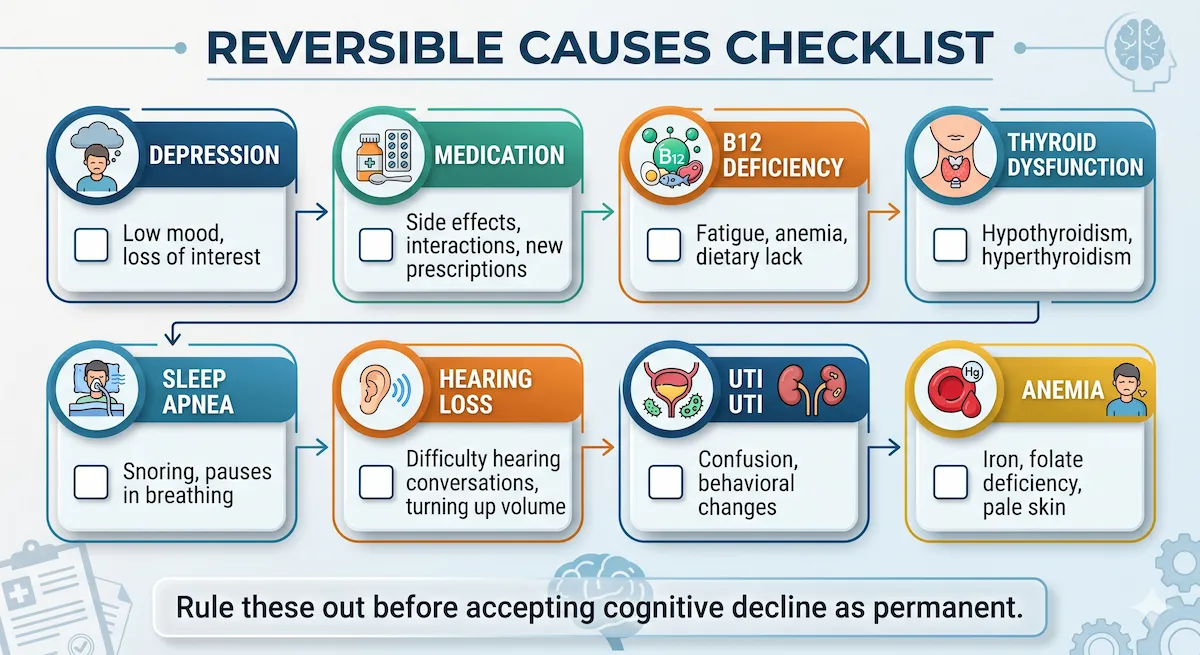
Reversible Causes: The Critical Check
Before concluding someone has irreversible cognitive decline, rule out reversible causes:
Reversible Cause | How to Detect | Why It Matters |
|---|---|---|
Depression | Screen with GDS-15; look for anhedonia, withdrawal, negative self-talk alongside memory issues | Very common; depression mimics cognitive decline; it's treatable |
Medication Side Effects | Review all medications; look for sedating drugs, anticholinergics, benzodiazepines | Some medications impair cognition significantly; stopping them can reverse decline |
Sleep Apnea | Ask about snoring, daytime sleepiness, witnessed breathing pauses; consider sleep study | Severely impairs cognition; very treatable |
Thyroid Dysfunction | TSH, free T4; hypothyroidism causes cognitive slowing | Easy to test and treat |
Vitamin B12 Deficiency | B12 level; look for megaloblastic anaemia, neuropathy | Causes cognitive and neurological symptoms; treatable |
Vitamin D Deficiency | 25-OH vitamin D level; common in India, linked to cognitive impairment | Treatable with supplementation |
Urinary Tract Infection (UTI) | Urinalysis; in seniors, UTI often presents as acute confusion or cognitive change | Acute; resolves with treatment |
Anemia | Hemoglobin, MCV; reduces brain oxygen delivery | Treatable depending on cause |
Hypertension | Blood pressure; both very high and very low BP impair cognition | Controlling BP can improve cognition |
Hearing Loss | Audiometry; hearing loss correlates with accelerated cognitive decline and is modifiable | Hearing aids can slow cognitive decline |
Before accepting cognitive decline as normal aging or dementia, rule out these. Many are simple blood tests. Some are reversible. All deserve checking.
Conclusion
Memory changes are frightening because they touch identity. Your parent's fear of becoming someone else is legitimate and deserves respectful attention. But fear also clouds judgment. Families either catastrophise every memory lapse (This is dementia) or minimise all of them (This is just normal aging).
The clinical reality lives in the middle: most memory lapses are normal aging. Some are early MCI. Few are dementia. But the distinction matters urgently because it determines whether intervention can help.
Your parent forgetting a colleague's name at dinner is almost certainly normal aging. Your parent forgetting what a colleague is, or what her daughter does for work, or how to manage her medications despite taking them for a decade these warrant evaluation.
The point is not to diagnose yourself. The point is to know when professional assessment is needed. And the time to seek that assessment is when cognitive changes are noticeable, frequent, and affecting function not when they're obvious enough to require a dementia diagnosis.
Early detection, in cognition, is where prevention actually works.
Red Alert Card: When Memory Changes Warrant Professional Evaluation
If your parent exhibits three or more of the following, cognitive assessment by a geriatrician or neuropsychologist is indicated:
Noticeable Decline from Their Baseline: They're worse than they were a year ago. Not just older, but noticeably more forgetful. You can sense the difference.
Frequency of Lapses: Memory issues are happening multiple times per week, not occasional. They're losing their keys repeatedly (not just occasionally). They're forgetting appointments, conversations, recent events on a regular basis.
Repetition of Stories or Questions: They tell you the same story multiple times within a week or month. They ask the same question they asked yesterday. This is not normal occasional repetition; this is frequent and noticeable.
Difficulty with Familiar Tasks: They're struggling with things they've done routinely for decades managing their cheque book, organising their medications, cooking a familiar recipe, using their phone. The task itself hasn't changed; their ability to do it has.
Getting Lost or Disoriented in Familiar Places: They get confused about the layout of their apartment, or the route to a place they've visited hundreds of times. They're unsure what day it is, or what month, more frequently than occasional.
Lack of Awareness About the Changes: Here's the critical one: They don't seem to notice or are unconcerned about memory losses that you've observed. You mention their forgetfulness, and they deny it or minimise it. (This is called anosognosia and is a neurological symptom, not stubbornness.)
Withdrawal from Engagement: They're losing interest in activities they used to enjoy reading, socialising, hobbies not because they're depressed (though that should also be assessed), but because the activities have become cognitively harder or they've forgotten why they matter.
Changes in Personality or Judgment: New irritability, impulsivity, or poor decision-making that's not characteristic of them. They're behaving differently in ways that concern you.
If three or more of these are present, this is not normal aging. This is MCI until proven otherwise. Get evaluation.
FAQs
My parent forgets where they put things. Is this normal or dementia?
How is mild cognitive impairment different from dementia? Can you have MCI forever without progressing?
My parent refuses cognitive testing. How do I approach this?