The Coffee Club Paradox
A common sight in Gurgaon apartments, particularly the high rise societies in DLF, Golf Course Road, is the senior who attends every community gathering, laughs at the right moments, and leaves promptly at 4 PM to return to a one-bedroom flat. On paper, they're socially engaged. In clinical reality, they're in what we call standby mode: present but not connected, moving through the motions of living while experiencing the weight of profound disconnection.
Your mother might have coffee with three friends twice a week and still report, quietly, that she feels no one truly understands her anymore. Your father might dominate the community club discussion and return home feeling emptier than before. This is not laziness or ingratitude. This is the border between loneliness and depression, and the distinction matters urgently for how you respond.
Why Gurgaon Amplifies This Problem
The architecture of modern Gurgaon - vertical, temperature-controlled, socially stratified, creates a unique pressure on senior mental health. Unlike joint families or neighborhood-based communities, high-rise living offers proximity without intimacy. Your parent can live surrounded by hundreds of people and feel utterly unseen. The humidity, the isolation behind glass, the commute required to reach actual friends (often scattered across different areas or may be even cities/states) these are not minor inconveniences. They are clinical risk factors.
Add to this the Sandwich Generation's own constraints: WhatsApp updates from Singapore, calls during lunch breaks, visits every alternate Sunday if traffic permits. Your parent learns to perform okayness because burdening you feels like betrayal. This performance, this standby mode becomes indistinguishable from actual contentment.
The Clinical Difference: Loneliness vs. Depression
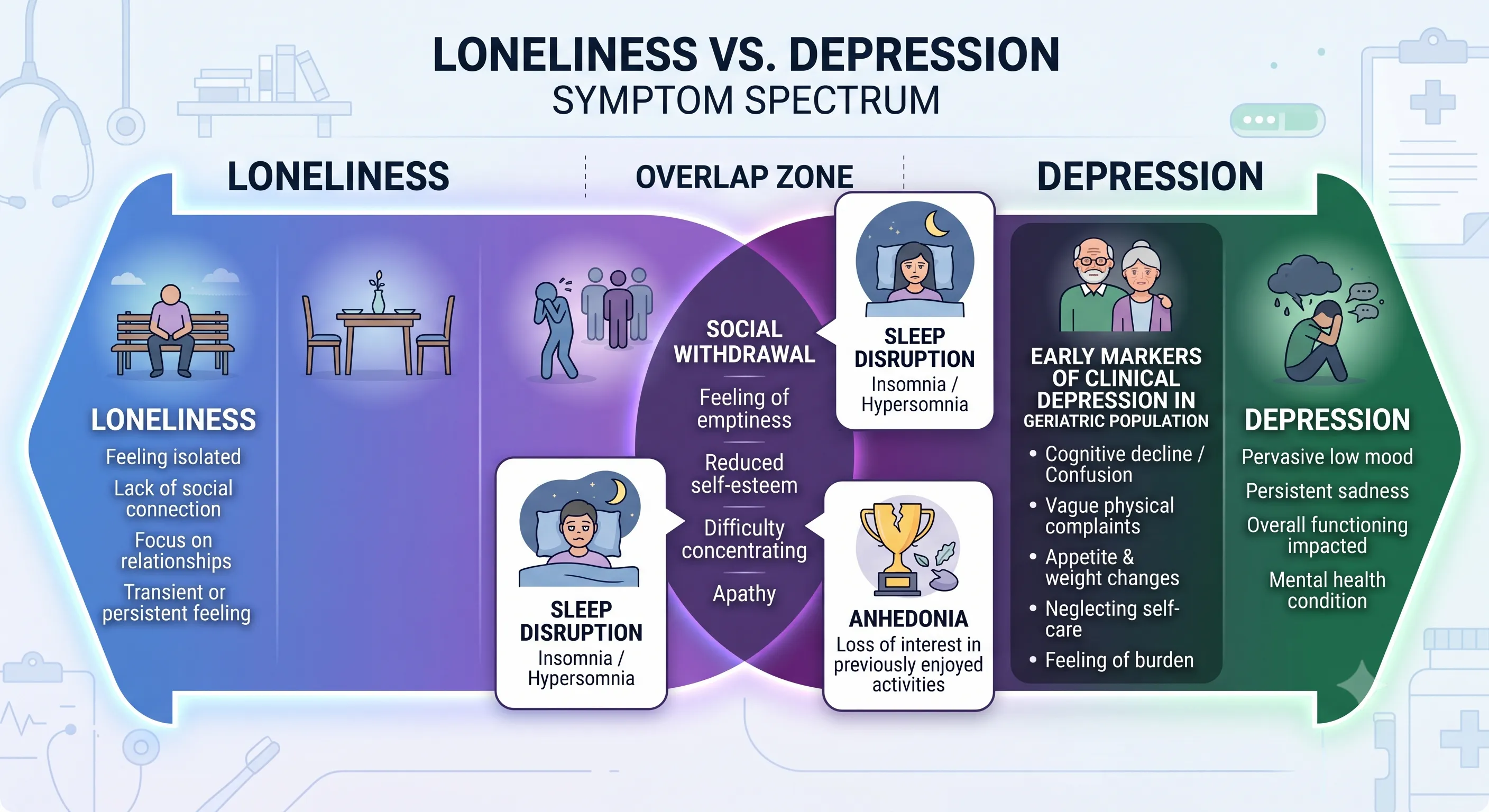
This is where precision matters. Loneliness and depression are often conflated, but they require fundamentally different interventions.
Dimension | Loneliness (Social Isolation) | Depression (Clinical Condition) |
|---|---|---|
Onset | Gradual; linked to specific life events (retirement, death of peer group, relocation) | Can be sudden or creeping; not always linked to external cause |
Response to Invitation | Accepts social engagement readily; feels better during interaction | Declines invitations; feels worse even during social time |
Pleasure in Activities | Retains enjoyment in hobbies, food, conversation | Anhedonia: loss of pleasure in everything (anhedonia is the clinical term) |
Sleep Pattern | May sleep poorly due to anxiety about isolation | Early morning awakening (3-5 AM) or hypersomnia; unrefreshing |
Appetite & Self-Care | Generally maintained; may neglect grooming due to lack of motivation | Marked loss of appetite or emotional eating; hygiene deteriorates |
Cognitive Function | Sharp; can articulate loneliness clearly | Slowed thinking, difficulty concentrating, rumination |
Timeline | Can improve with one meaningful connection | Requires intervention; doesn't resolve with social engagement alone |
Suicidal Ideation | Rare | Present in 10-15% of cases; must be assessed directly |
The Neurobiology: Why Isolation Becomes Depression
Understanding the mechanism helps you respond with both compassion and urgency.
When a senior experiences prolonged social isolation, several things happen at the neurochemical level:
Inflammatory Cytokine Release: Social isolation triggers persistent low-grade inflammation in the brain, particularly in regions governing mood (the prefrontal cortex and limbic system). This is not metaphorical - it's measurable in blood work (elevated IL-6, TNF-alpha).
Dopamine and Serotonin Depletion: Without novel social stimuli, the brain downregulates production of these neurotransmitters. The reward pathway becomes less responsive. This is why your parent might say, Nothing feels fun anymore.
Cortisol Dysregulation: Chronic loneliness keeps cortisol (stress hormone) elevated, even at rest. This causes the early morning awakening pattern and the sense of dread upon waking.
Accelerated Cognitive Decline: Isolation accelerates cognitive aging by 10-15 years according to recent longitudinal studies. This creates a vicious cycle: cognitive decline → withdrawal → further decline.
The crucial point: Loneliness, if untreated over 12+ months, becomes depression. It's not just an emotional state; it's a biological process.
Intervention Framework
Given Gurgaon's specific challenges that come with urban migrant population, here's how to move from observation to action:
Step 1: Assess, Don't Assume
Have a direct conversation with your parent. Use this framework:
I've noticed you seem quieter lately. Can you help me understand what a typical day feels like for you? Not the facts - the feeling. Are you lonely? Do you feel sad? Are activities fun anymore?
Listen for the difference between I have no one to talk to (loneliness) and I don't see the point in talking anymore (depression).
Step 2: Address Logistics, Not Just Sentiment
Loneliness in Gurgaon is partly structural. If your parent lives in Sector 47 and their friends are scattered across Sectors 31 and 50, transportation becomes a clinical factor. Does your parent:
Have reliable access to transport?
Know how to use cab aggregators (Uber, Ola)?
Have neighbors or building communities they can actually walk to?
These are not trivial. A senior who feels socially isolated because they can't physically access their peer group needs solutions (cab credits, building activity groups, proximity-based clubs), not antidepressants alone.
Step 3: Differentiate the Intervention
If it's loneliness:
Increase meaningful social contact (not just presence; quality over quantity)
Solve the logistics of connection
Identify one or two people who can be consistent touchpoints
Introduce structured social environments (book clubs, fitness groups, community spaces)
If it's depression:
Schedule a geriatric psychiatrist evaluation (ideally someone who understands geriatric-specific depression, which presents differently than younger-adult depression)
Do not rely on social engagement as the sole intervention
Consider medication if indicated
Run basic labs to rule out physical causes (B12, thyroid, vitamin D)
Conclusion
Your parent in standby mode is not choosing isolation. They're navigating a city designed for mobility, managing identity loss after retirement, and protecting you from their vulnerability. The distinction between loneliness and depression is the difference between a solvable logistics problem and a medical condition requiring intervention.
You cannot fix either with guilt or weekend visits alone. But you can see clearly. And seeing clearly is the first step toward effective response.
The coffee club exists. The friends are there. But connection requires clinical precision, understanding not just where your parent is, but why they're there, and what kind of help actually reaches them.
When Loneliness Becomes Depression
Do not assume these are the same thing. If your senior exhibits three or more of the following, clinical depression is likely present and requires professional assessment:
Anhedonia: They've stopped enjoying activities they once loved - the book club feels pointless, the morning walk feels like a burden, even calls from grandchildren feel exhausting rather than joyful.
Early Morning Awakening: Waking at 3 or 4 AM and unable to return to sleep, combined with a sense of heaviness in the early hours (this is distinct from simple insomnia).
Persistent Negative Self-Talk: Phrases like I'm a burden, No one would miss me if I wasn't here, I've ruined my life, Everyone's better off without me.
Appetite Collapse or Emotional Eating: Sudden disinterest in food that was previously enjoyed, or conversely, eating to numb emotions.
Fatigue That Doesn't Improve with Rest: They sleep 10 hours and still feel exhausted. The fatigue is neurochemical, not physical.
Neglect of Hygiene or Appearance: A senior who previously took pride in grooming now wears the same clothes for days, skips bathing, or stops going to the salon.
Suicidal Statements, Even Fleeting: I won't be around much longer, It would be easier if I just didn't wake up, You won't have to worry about me soon. These are immediate red flags.
If any of the above are present, your parent needs a geriatric psychiatrist or physician evaluation, not just social engagement. Loneliness can be addressed by you. Depression requires clinical intervention.
FAQs
My mother says she's lonely, but I'm worried it's depression. How do I know if professional help is needed?
Is depression in seniors different from depression in younger adults?
Can social isolation itself cause lasting brain changes?