
Cervical spondylosis is considered a natural process of ageing, with a 95% prevalence by age 65. Read that again: ninety-five percent. By the time a person reaches 65, nearly every one of them will have detectable degenerative changes in the cervical spine on imaging. Yet most of them are entirely asymptomatic and the ones who are symptomatic are frequently managed with a combination of painkillers, a heating pad, and the instruction to "rest." That is not a management plan. It is, at best, a holding pattern.
Conflating radiological findings with clinical destiny
When a 67-year-old woman complains of neck stiffness, occasional headaches, and a tingling sensation in her right arm, the family rushes her for an X-ray or MRI. The report comes back: multilevel cervical spondylosis with disc space narrowing and osteophyte formation. The family is alarmed. The patient is told she has a "bone problem" in the neck and is advised rest, a cervical collar for daily use, and a painkiller as needed.
Three things are wrong with this response. First, the X-ray finding, however alarming it looks on paper, tells us almost nothing by itself because of the pervasiveness of degenerative changes in asymptomatic patients, a clear correlation of symptoms, physical signs, and imaging findings is required before any specific diagnosis can be made. Second, prolonged rest and collar use are not neutral interventions — they cause muscle deconditioning that worsens the condition over time. Third, the tingling in the arm may indicate cervical radiculopathy i.e. nerve root compression, which has specific clinical implications that generic advice about rest does not address.
The gap between "cervical spondylosis on imaging" and "what this means for this particular patient" is where most of the mismanagement happens. Families deserve a clearer picture.
What actually happens in the ageing cervical spine
The cervical spine consists of the seven vertebrae of the neck, it is a complex structure of bones, intervertebral discs, facet joints, ligaments, and the nerve roots that exit through lateral foramina at each level, alongside the spinal cord itself running through the central canal.
Cervical spondylosis is the umbrella term for the degenerative cascade that unfolds across all these structures with age. It begins with the intervertebral discs, the shock-absorbing pads between vertebrae losing their hydration and height. This disc dehydration reduces the spacing between vertebrae, transferring load onto the facet joints and the vertebral endplates. In response, the body produces osteophytes (bony outgrowths) at the vertebral margins. Simultaneously, the ligamentum flavum, which lines the posterior spinal canal, thickens and can buckle inward.
This process has three possible clinical consequences, each distinct in its presentation and management:
Axial neck pain - pain localised to the neck itself, with stiffness and restricted range of motion, it arises from the facet joints and surrounding muscles. This is the most common presentation and the most benign.
Cervical radiculopathy - compression or irritation of a nerve root as it exits through the narrowed foramen, produces pain, numbness, tingling, or weakness radiating down one arm, in a pattern corresponding to the specific nerve root involved. C6 and C7 roots are most commonly affected, producing symptoms in the forearm, thumb and index finger (C6) or middle finger and hand (C7).
Cervical myelopathy - compression of the spinal cord itself is the most serious consequence. Myelopathy develops in approximately 5% to 10% of patients with clinically symptomatic spondylosis, but cervical spondylosis is the most common cause of myelopathy in middle-aged and elderly patients. Myelopathy produces a specific clinical picture: clumsy hands, difficulty with fine motor tasks like buttoning clothes or writing, unsteady gait, and in advanced cases, bladder dysfunction. The classic triad that should prompt suspicion of cervical myelopathy is poor hand dexterity, new unsteady walking patterns, and new-onset and growing problems with motor abilities.
The critical clinical problem is that myelopathy symptoms such as gait unsteadiness, hand clumsiness, reduced fine motor control are easily and dangerously mistaken for normal ageing, Parkinson's disease, or general deconditioning. Worsening symptoms may be present for some time and are wrongly attributed to functional impairment due to aging.
The clinical reality for Indian seniors in Gurgaon
For seniors in Gurgaon's high-rise apartments, the daily mechanics of cervical spondylosis carry a specific local dimension. Extended screen time smartphones held low, tablets on the lap, televisions at awkward angles produces sustained forward neck flexion that dramatically increases compressive load on the cervical discs. This is not a problem unique to younger people; urban Indian seniors use smartphones extensively, and posture during use is rarely corrected.
The staircase and lift dynamics of buildings add another layer: sudden forceful neck extension such as looking up at a high floor indicator in an elevator lobby, or craning to speak with someone on a higher step in a spine with already narrowed foramina can acutely worsen radicular symptoms.
The clinical pattern I see most frequently is an elderly patient who has been managing "neck pain" with over-the-counter pain medication for a year or more, while the underlying nerve root compression has quietly been causing weakness and sensory loss in one arm findings that go unnoticed because nobody performs a formal neurological examination of the upper limbs at a routine check-up.
What Helps: The Evidence-Based Approach
1. Structured physiotherapy is the single most evidence-supported intervention
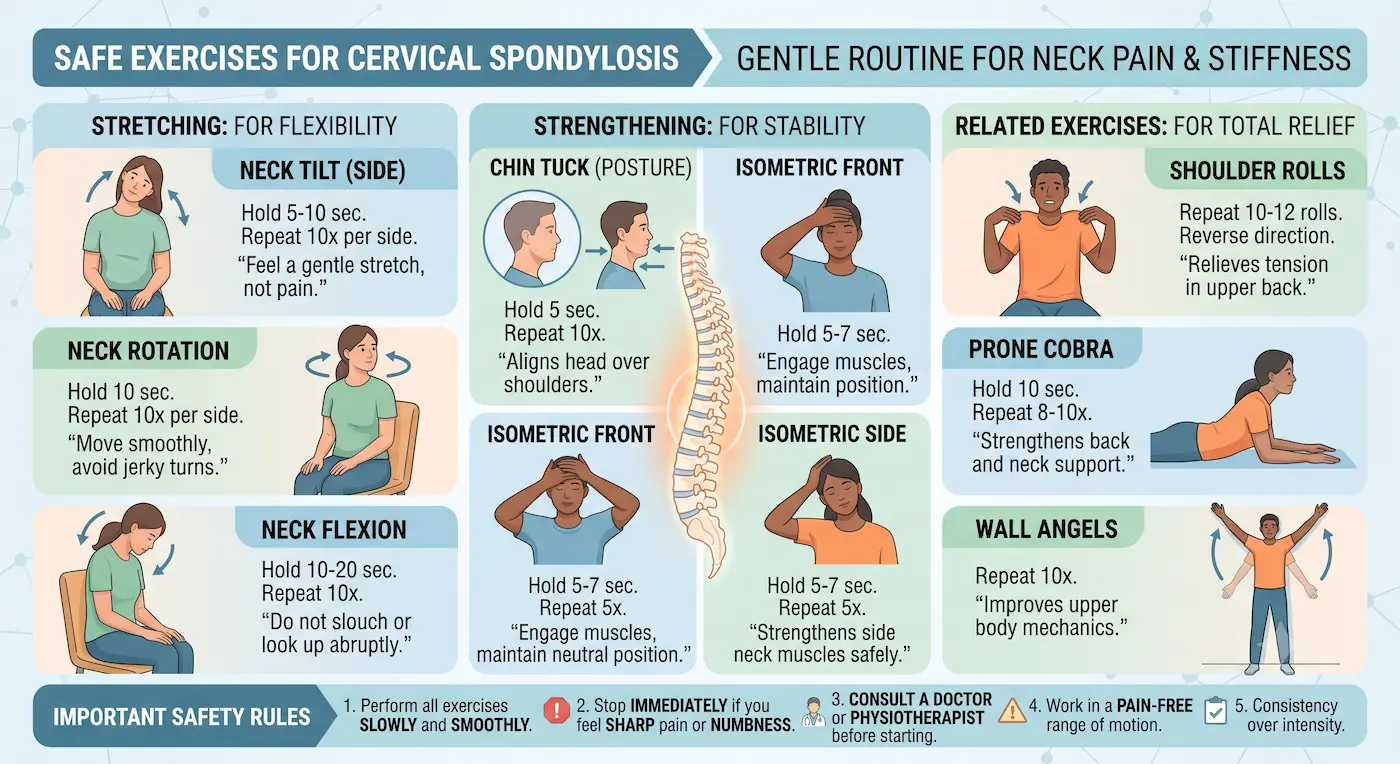
The mainstay of nonsurgical treatment is a 4- to 6-week course of physical therapy, including isometric and resistance exercises to strengthen the neck and upper back muscles. A randomised controlled trial specifically examining isometric exercises in cervical spondylosis found that the exercise group demonstrated significantly lower neck disability index scores and neck pain scores compared to conservative management without exercise after just four weeks.
Treatment should be tailored to the individual and include supervised isometric exercises, proprioceptive re-education, manual therapy, and posture education. The key word is supervised self-directed neck exercises performed incorrectly can worsen symptoms, particularly in patients with radiculopathy.
2. Postural correction and ergonomic adjustment
The cervical spine's neutral position is its most mechanically efficient. Any prolonged deviation forward head posture from screen use, pillow height that flexes or extends the neck during sleep, sustained neck rotation during prayer or cooking incrementally worsens compressive load. A cervical contour pillow that maintains neutral neck alignment during sleep is a simple, evidence-informed intervention that many seniors have never been advised to try.
3. Gentle, consistent movement and not rest
People who walk daily are less likely to experience neck and low back pain. Sustained rest leads to muscle deconditioning, which reduces the dynamic support available to the cervical spine and worsens pain over time. For seniors with axial neck pain or mild radiculopathy, the goal is to maintain movement within a comfortable, pain-free range & not to immobilise.
4. Medication for symptom management and not as a standalone treatment
NSAIDs and muscle relaxants can provide meaningful short-term relief during acute flares but carry significant risks in elderly patients: GI bleeding, renal impairment, and drug interactions. They address symptoms, not the underlying structural problem. Nonoperative treatment, although effective, is labour intensive, requiring regular review and careful selection of medications and physical therapy on a case-by-case basis. A blanket long-term NSAID prescription in a senior with cervical spondylosis is not management, it is deferred management.
5. Surgery - when and only when specific criteria are met
Surgery is not recommended for prophylactic decompression in asymptomatic patients or in those patients with neck pain in the absence of extremity symptoms. In most patients with radiculopathy or mild myelopathy, a trial of nonsurgical management is recommended. Surgery is indicated when myelopathy is moderate to severe, when neurological deficit is progressive, or when conservative management has genuinely failed over an adequate trial period. A senior being pushed toward surgery for neck pain alone, without neurological deficit, warrants a second opinion.
What Doesn't Help
Prolonged cervical collar use. A soft cervical collar worn continuously weakens the neck muscles it is supposed to protect, increases dependence, and provides negligible actual immobilisation. Soft cervical collars are recommended for daytime use only and even then only in specific clinical contexts, not as routine management for axial neck pain.
Forceful neck manipulation by an unqualified practitioner. High-velocity neck manipulation, common in some traditional therapy settings, in a spine with advanced spondylotic changes carries the risk of acute cord compression or vertebral artery injury. This is not a theoretical concern. Families must be explicitly warned against sending an elderly parent with diagnosed cervical spondylosis for aggressive neck manipulation.
Ignoring myelopathic symptoms as "old age." Hand clumsiness, gait unsteadiness, and difficulty with fine motor tasks in an elderly person with known cervical spondylosis should always prompt an MRI to assess cord compression & not reassurance.
Physical modalities without exercise. A meta-analysis by the Philadelphia Panel found that physical modalities such as cervical traction, heat, cold, therapeutic ultrasound, massage, and transcutaneous electrical nerve stimulation lacked sufficient evidence regarding their efficacy in treating acute cervical pain when used in isolation. They may provide short-term comfort, but without structured exercise addressing muscle strength and posture, they do not change the underlying trajectory.
At Aamra Seniors Club, our doctor-led day programme includes structured movement, postural guidance, and clinical oversight that keeps small neurological changes from becoming large ones. Book a Day Pass.
Critical Warning: Any of the following symptoms in an elderly patient with known or suspected cervical spondylosis require urgent neurological evaluation & not a wait-and-watch approach: sudden or rapidly progressive weakness in both arms or legs; loss of bladder or bowel control; new-onset unsteady gait appearing over days to weeks; or a significant fall following a neck injury. These may indicate acute spinal cord compression which is a surgical emergency. Do not attempt neck manipulation or traction in the home setting in any patient exhibiting these symptoms.